

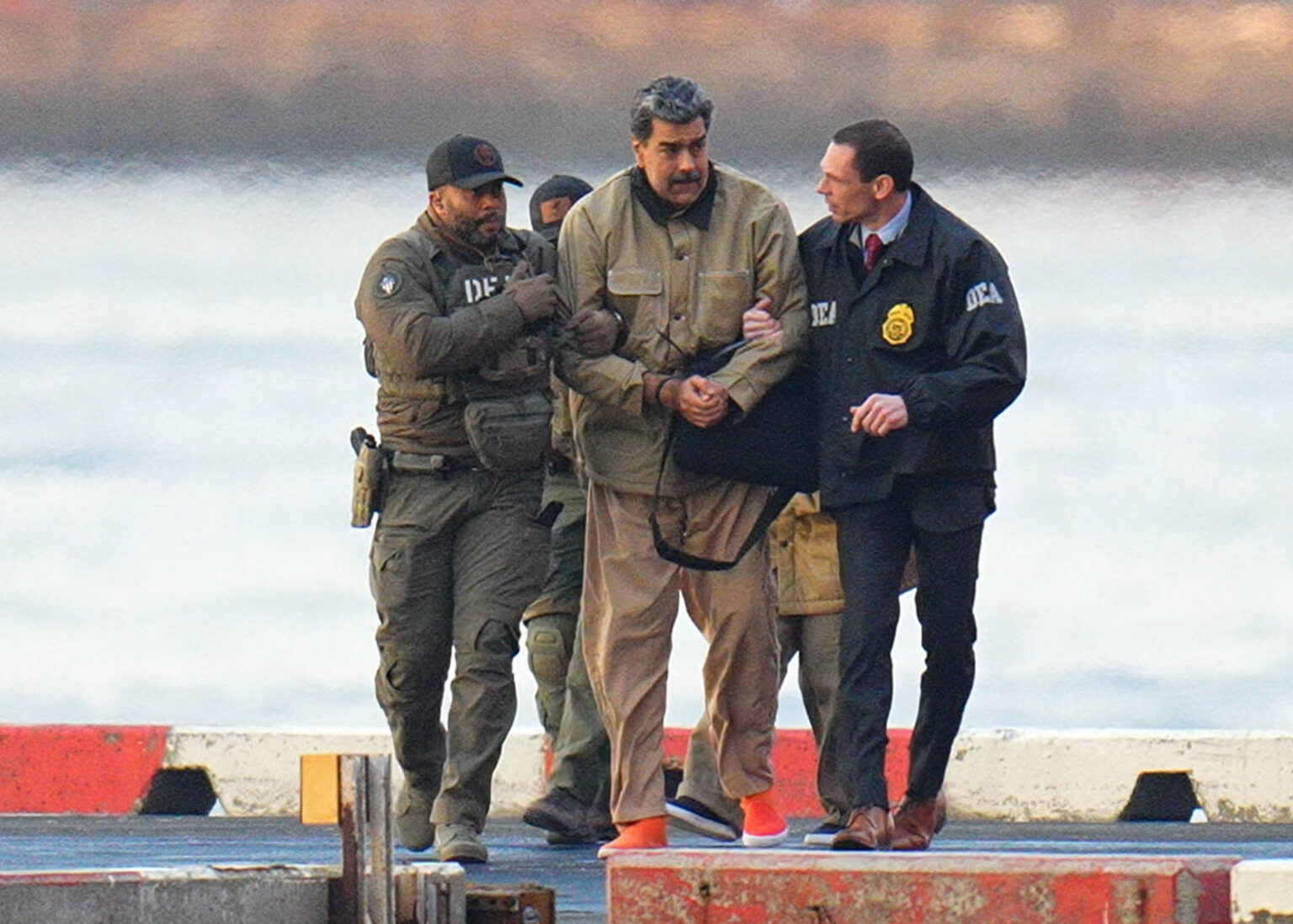




January 3, 2026 will go down in history as the date of an unprecedented military operation : the United States captured Nicolás Maduro in Caracas and transferred him to New York to stand trial. This coup, hailed by some as the end of an authoritarian regime and denounced by others as a violation of international law, has propelled Venezuela into the heart of a global geopolitical crisis.
A few days ago, the US military operation dubbed Operation Absolute Resolve targeted several strategic sites in northern Venezuela, including the capital Caracas. Nicolás Maduro and his wife Cilia Flores were captured by US special forces, who then exfiltrated the presidential couple out of the country and took them to the United States.
Once in New York, Maduro appeared before a federal court, where he pleaded not guilty to charges of narco-terrorism, drug trafficking, and possession of heavy weapons. He and his family are currently being held without bail.
Delcy Rodríguez, Maduro’s former vice president since 2018, has been proclaimed interim president, but the real authority of this government remains unstable given the country’s current fragility.
The reasons behind a daring operation
Succeeding Hugo Chávez as Venezuela’s leader in 2013, Nicolás Maduro inherited a country still shaped by the Bolivarian revolution but already facing deep divisions. Although rich in oil, the country was already plunging into a deep crisis before the events of January 3 : economic mismanagement, inflation, insecurity, collapse of public services, etc. Maduro plunged the country into chaos, continuing a political trajectory marked by the affirmation of an anti-American model that had begun under his predecessor.
Relations with the United States deteriorated over the years, not only under Donald Trump‘s presidency but under various US administrations. Washington has described the Caracas regime as authoritarian and imposed targeted economic sanctions against Venezuela, while accusing Maduro and his entourage of involvement in drug trafficking networks. These accusations culminated in US legal proceedings for narco-terrorism and trafficking.
In addition to disastrous economic management, Venezuela’s democratic institutions were subsequently weakened by Maduro through the prosecution of the opposition, human rights violations, and civilian deaths during protests. Under Maduro’s presidency, millions of Venezuelans fled the country…
Donald Trump thus legitimized the operation as a necessary measure to protect the United States from the devastating consequences of drug trafficking and, according to him, to restore democracy in Venezuela. He also publicly mentioned the United States’ intention to temporarily rule the country in order to facilitate a political transition.
Shockwaves around the world
The American intervention sent diplomatic shockwaves around the world. It must be said that we have not seen such determination from our leaders for many years. While some countries, such as Brazil, Colombia, Russia, and China, condemned the operation as a flagrant violation of the United Nations Charter and Venezuelan sovereignty, others, such as Italy, Argentina, and Kosovo, welcomed and supported the US move.
Others remained more moderate, such as the United Kingdom and Germany, which welcomed the end of Maduro’s regime while remaining skeptical about the method used. As for France, Emmanuel Macron commented on the fall of the Venezuelan regime in relatively positive terms, considering that the Venezuelan people could rejoice at the fall of what he called the “Maduro dictatorship” and calling for a “democratic and peaceful transition for the country,” before backtracking somewhat by stating that France “neither supports nor approves” the method used by the United States to capture Maduro.
What about international law ?
According to international law experts, there was no UN Security Council mandate that could legitimize the use of force by the United States in Venezuela. Under international law, Article 2.4 of the UN Charter prohibits a state from using force against another country, except in two specific cases : in self-defense in response to an armed attack, or if an explicit Security Council resolution authorizes the use of force in a particular context.
Technically, this US intervention does not fall within the framework of a response to direct armed aggression or an imminent threat, even though Washington presented it as a law enforcement action against an accused person.
Furthermore, the Security Council did not adopt any resolution giving the green light to this operation. Consequently, the operation is legally questionable because there is nothing in the international legal framework that allowed the United States to enter Venezuelan territory militarily and capture a sitting head of state.
This lack of a clear mandate and legal justification makes the operation controversial under international law and fuels criticism that the norms established after World War II to limit the use of force between states have been ignored.
Despite this, several analysts point out that international law leaves gray areas that major powers can exploit when their strategic interests are at stake. Washington is thus relying on an interpretation of national security and the fight against criminal networks to justify this action, arguing that inaction would have posed a greater risk.
Read also > Greenland, the future and only imperialist ambition of the United States?
Featured photo : © Getty Images