





In 1916, a nurse at the Hôpital des Invalides, deeply moved by the sight of soldiers returning from the front with injuries sustained during the Great War, decided to ease their pain and distract them from their boredom by inviting them to make paper cornflowers. Like the poppy for the British and Commonwealth countries, this flower, capable of growing even in the mud of the trenches, has for a hundred years symbolized remembrance and solidarity with wounded soldiers, their widows, and victims of terrorism.
A terrible conflict, so much so that it was nicknamed by its contemporaries as “the war to end all wars” (at least, that was their hope), World War I not only caused more than 9 million deaths and missing persons (4 million in France), it also left its share of wounded and maimed (3.5 million individuals), including the infamous “gueules cassées” (broken faces). In 1916, the “terrible year” of the Battle of Verdun (February 21 to December 18), an initiative was launched at the Hôpital des Invalides: the making of paper cornflowers.
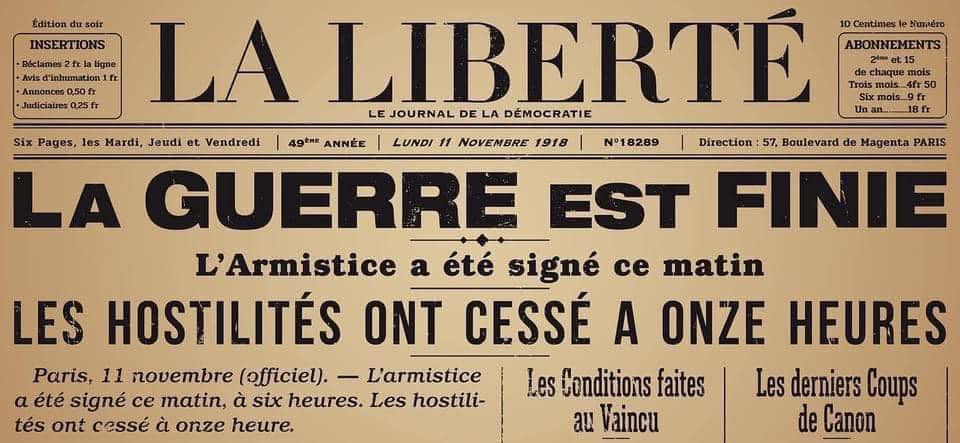
At dawn on November 11, 1918, the French general staff signed the armistice in the presence of a German delegation in a railway carriage belonging to the Compagnie des Wagons-Lits, in the forest of Compiègne, a short distance from the village of Rethondes, in the Hauts-de-France region (North of France).
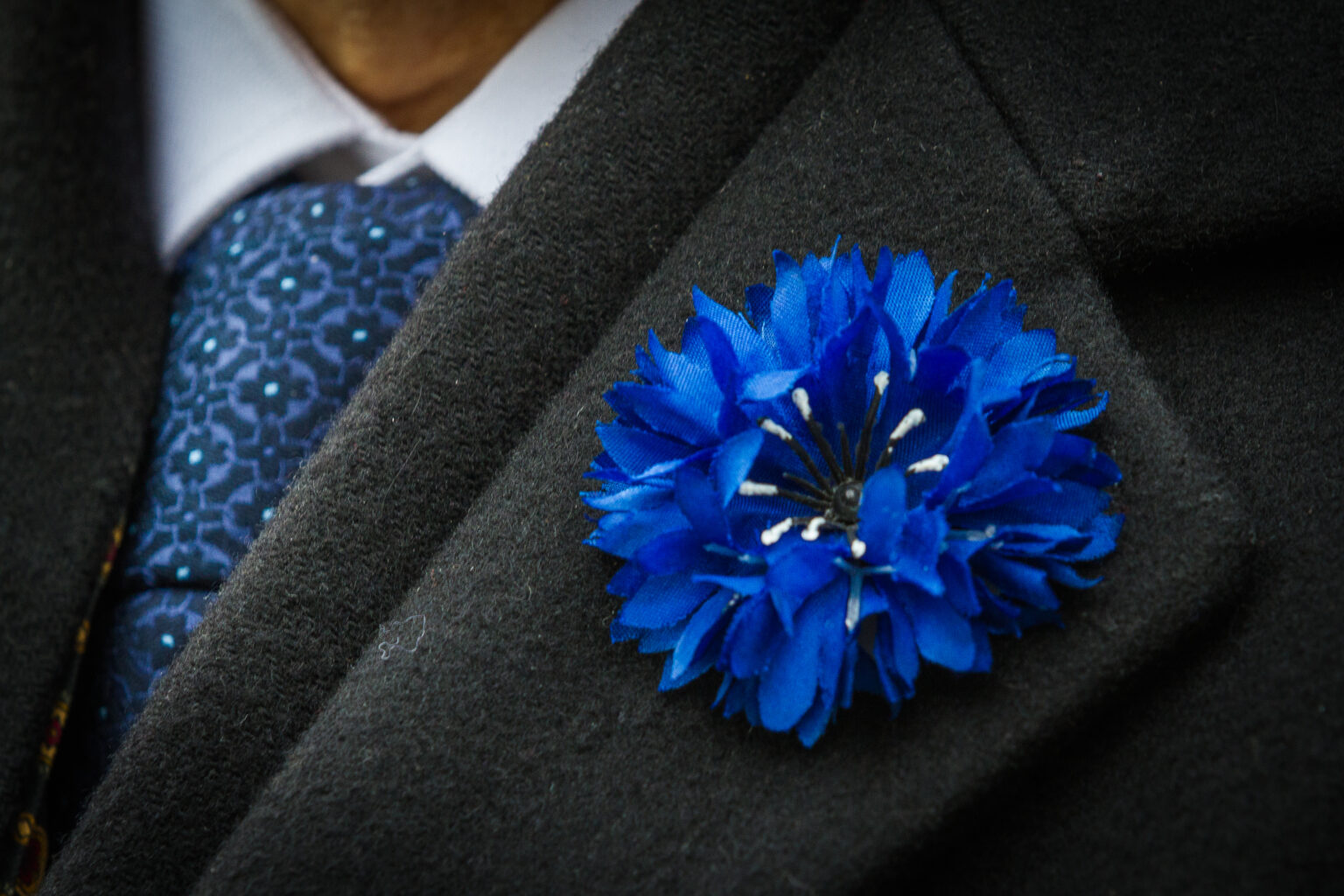
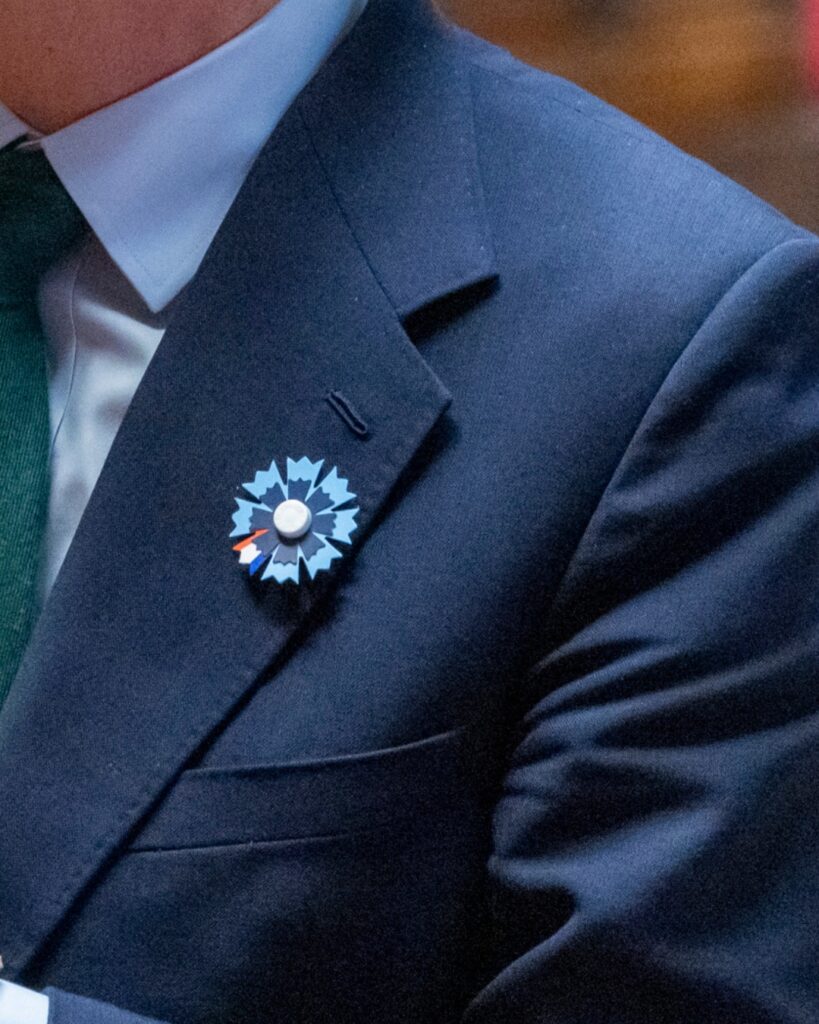
Thus, on each anniversary of the 1918 armistice, it is customary to wear insignia in the shape of cornflowers (made of paper or metal) in one’s buttonhole. These are sold by the state in order to financially support war wounded of yesterday and today and, more generally, to “help those who remain,” which is its primary mission.
A tender heart and a tough flower
Although the French chose the cornflower as a symbol to commemorate veterans and war wounded, the reason for this choice is not to be found in the language of flowers. According to this language, this wild plant evokes delicacy and shyness and is “the messenger of all pure, naive, or delicate feelings.”
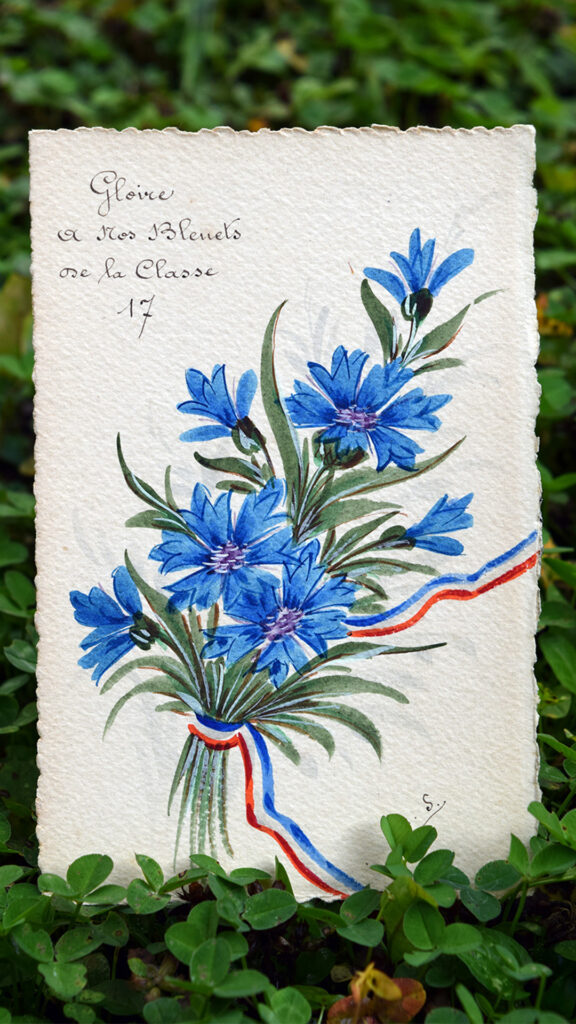
Its bright blue color is reminiscent of the horizon blue uniforms of the French infantry from 1915 to 1921. This color is inseparable from the poilus, located between “bluish iron gray” and “sky blue”, adopted by the general staff in 1912 on the grounds that it was more difficult to target than blue and red uniforms. This similarity also led to the soldiers themselves being nicknamed “les bleuets”.
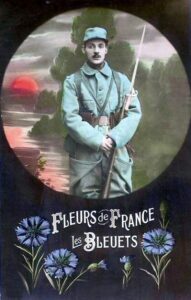
Furthermore, cornflowers have the distinctive feature of growing in meadows and fields, which is where the most terrible battles of the First World War took place. These wild plants are often the last vestiges of life in devastated landscapes.
Thus, in 1916, two women, shaken by the horror of war and its severely wounded victims, decided to set up a workshop to make bouquets of paper cornflowers at the Hôtel des Invalides. They were head nurse Suzanne Lenhardt and Charlotte Malleterre, daughter of General Gustave Léon Niox, commander of the Hôtel national des Invalides, and wife of General Gabriel Malleterre. The floral creations replicated the serrated edges of the petals and were used, initially, to commemorate the soldiers who fell for France between 1914 and 1918.
A symbol that lives on today
In the aftermath of the First World War, the Bleuet de France association was created. The cornflower was no longer used solely to remember the dead, but also to provide material and human support to the living.
The institution was used to provide financial resources to former soldiers who had been maimed or wounded. It was not until 1934 that the sale of cornflowers was systematized by the state every November 11. Since 1957, a new collection of donations has been authorized on May 8 for the benefit of World War II veterans.
Since 1991, the association has been attached to the National Office for Veterans and War Victims (ONACVG), a public institution under the supervision of the Ministry of the Armed Forces.
In recent years, the Œuvre nationale du Bleuet de France has given new visibility to the cornflower, to the point where its symbolic nature is increasingly recognized by the French.
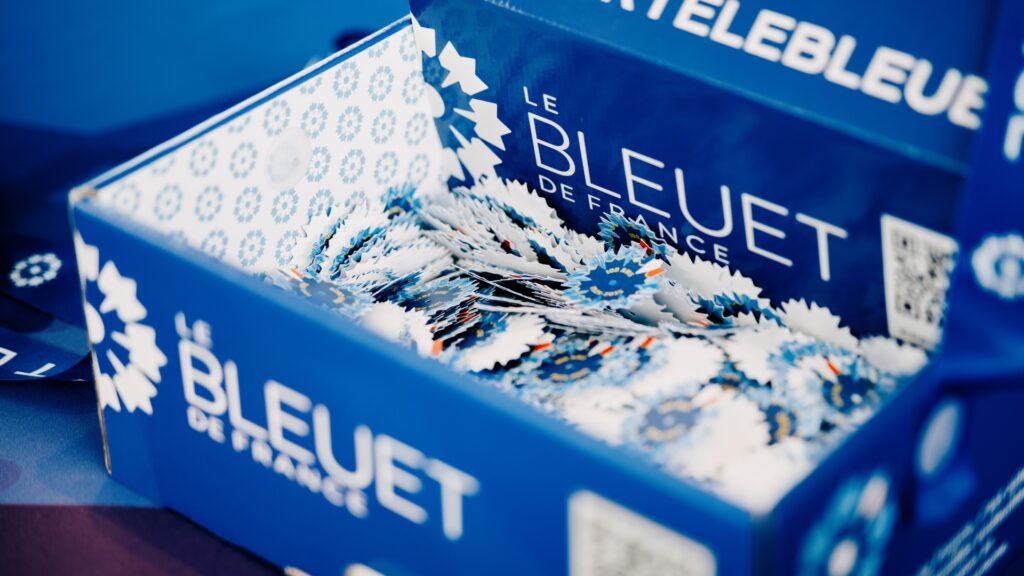
When the last veteran of the Great War passed away in 2008, Bleuet de France extended its mission to bereaved families, wards of the nation, and victims of terrorism.
Part of the funds raised are used to finance remembrance initiatives, particularly those aimed at schoolchildren. Throughout the year, Bleuet de France partners with events that are close to the hearts of the French people in order to raise awareness of its cause. The association was notably present at the Paris Marathon last April.
Since July 14, 2023, at the request of President Emmanuel Macron, the entire population (military and civilian) is invited to wear a cornflower in their buttonhole during commemorations of major world conflicts (November 1 to 11 and May 1 to 8), as well as every March 11 (National Day of Remembrance for Victims of Terrorism) and every July 14, France’s national holiday.
Read also > Eighty years ago in Hiroshima, the world discovered the fear of nuclear weapons
Featured photo: DR