

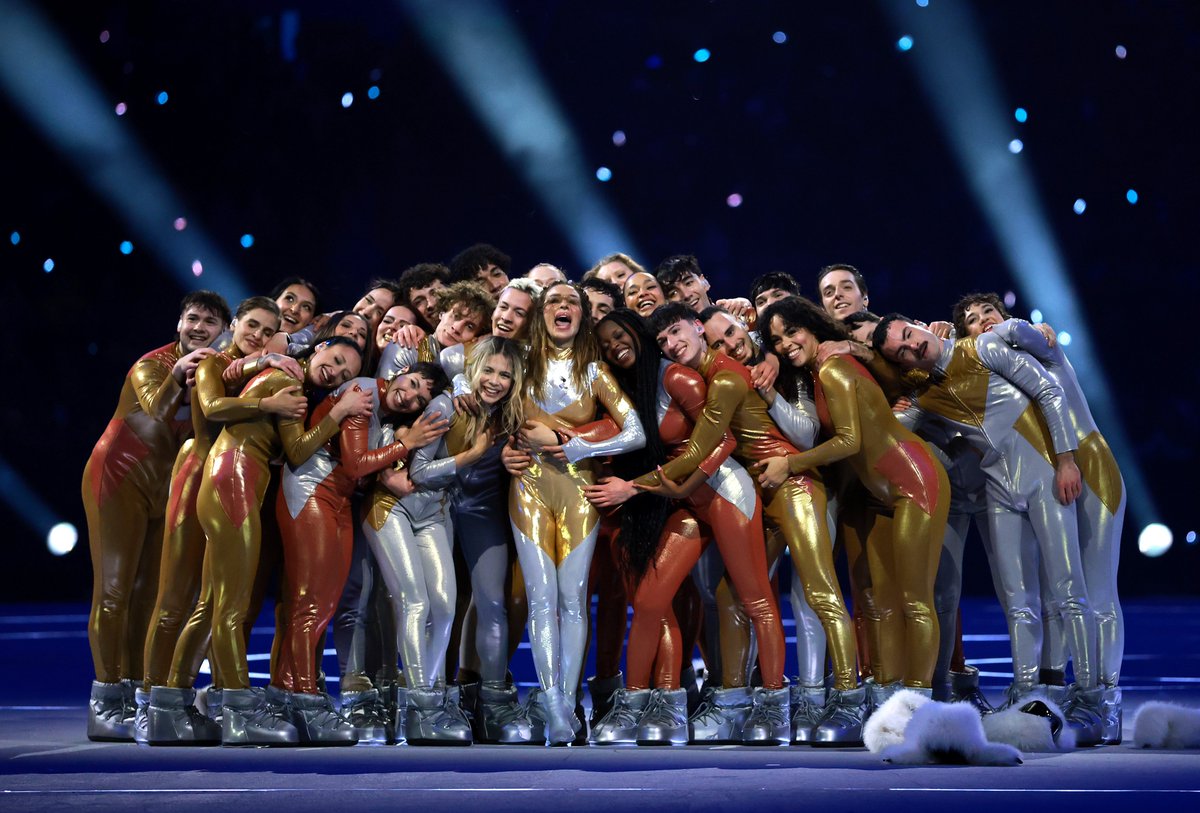




On Friday, February 6, the iconic San Siro Stadium vibrated in unison with the launch of the Milan-Cortina Olympic Games. The Italian host delivered a more conventional and extensive opening ceremony than Paris 2024, while multiplying spectacular moments and moments of grace between the tribute to Giorgio Armani and performances by artists Andrea Bocelli, Mariah Carey, and Sabrina Impacciatore, actress from the series The White Lotus.
Since Friday, the Milan Cortina Olympic fortnight, the 25th edition of the Winter Olympics, has been officially open.
From February 6 to February 22, three transalpine regions (Lombardy, Veneto, and Trentino-Alto Adige) will host certain Winter Olympic disciplines in no fewer than eight host locations.
This multi-site fragmentation—which contrasts sharply with Paris 2024, intended by the organizers to offer the Games to as many people as possible — also aims to limit the final bill by optimizing the use of existing infrastructure to organize the various events, particularly those from the 1956 Olympic Games in Cortina d’Ampezzo and the 2013 Winter Universiade in Trentino.
The opening ceremony, watched by more than 2 billion people worldwide, including 60,000 in Milan’s San Siro Stadium—before its upcoming demolition to make way for the Stado Milano—also benefited from this philosophy, with the ceremony taking place simultaneously in Milan, Cortina, Predazzo, and Livigno. This was a first in the history of the Winter Olympics.
For Italy, it was important to compete with the Paris Summer Games, especially since France is set to host the Winter Olympics in 2030 in the Alps. The country also opted for personalized basins and an Olympic village that will be converted into student housing and commercial space once the festivities are over.
A spectacular show
In a more conventional style, with a real parade of athletes, Italy showed that it had lost none of its sense of spectacle, a legacy of the Roman Empire. The opening ceremony attempted to convey, through the theme of “Armonia” (harmony), all of Italy’s creative genius, from fashion to music, design, and even gastronomy, with cuisine having been recognized as part of UNESCO’s world heritage.
In addition to painting, with a painting referring to Leonardo da Vinci, music and opera were of course also featured, with XXL mascots representing Verdi, Puccini, and Rossini.
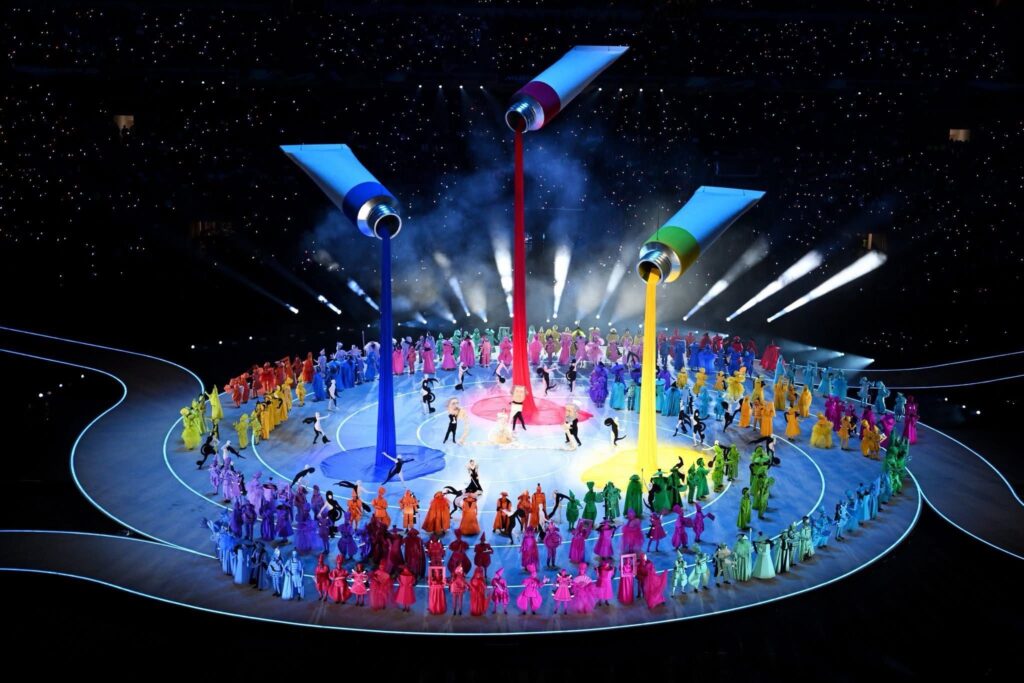
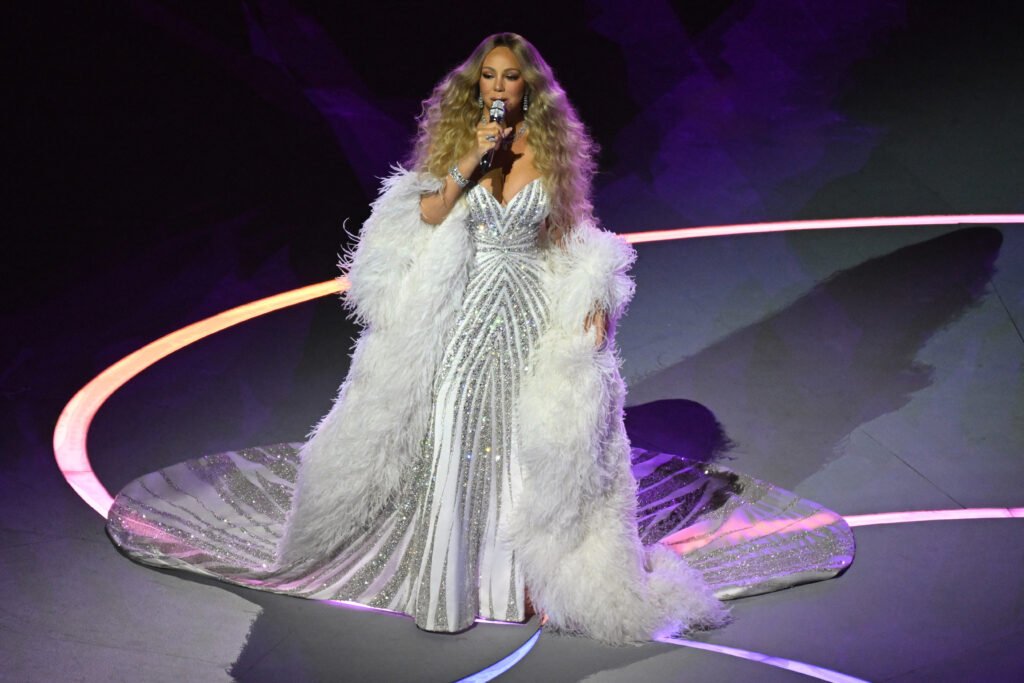
And as is often the case with Italians, decorum does not necessarily imply rigidity—quite the contrary, in fact. Mariah Carey was chosen to perform a classic Italian pop song from the 1950s, written and composed by Domenico Modugno, Nel blu dipinto di blu (“In the blue painted blue” in Italian), better known as Volare.
A timeless icon with her blonde bob, Raffaella Carrà, best known for her disco hit “A Far l’amore comincia tu” (“Start making love” in Italian), released in 1976, was also honored. She was a showgirl who managed to bring Italy out of its shell in the 1970s, not hesitating to appear on television with her midriff exposed.
Luciano Pavarotti was undoubtedly the other prominent figure at the ceremony. His Nessun Dorma, from Puccini’s opera Turandot, was reinterpreted by another maestro of the voice, Andrea Bocelli.
Finally, the star of Italian pop and another singer with a powerful voice—more tearful than Mariah Carey, who made her debut at the San Remo Festival with her song La Solitudine (1993)— Laura Pausini had the honor of performing Inno di Mameli (“Mameli’s Hymn”), the Italian national anthem. This performance was all the more meaningful as the President of the Italian Republic since 2015, Sergio Mattarella, had made the trip to the Milan stadium.
Another compatriot, famous internationally and particularly across the Atlantic, Sabrina Impacciatore made a lasting impression with a dance performance set to the music of Adriano Celentano, on the history of the Winter Olympics from the first edition in Chamonix in 1924 to the present day. The actress (also a presenter) is known for her role of Valentina in season 2 of the Netflix series The White Lotus, which was filmed in Taormina, Sicily. She has also been spotted in another series: the spin-off of The Office, The Paper. On the official website of the Milano-Cortina Games, the organizers emphasize her embodiment of “Armonia,” a form of contemporary Italian creativity that combines depth and lightness, irony and seriousness, in a universal language.
Finally, simulating a technical problem, popular Italian television actress and presenter Brenda Lodigiani showed that Italy has mastered self-deprecation with a silent sketch on “Italian sign language,” as Italians often use gestures to express certain ideas or emotions.
Tribute to Italian craftsmanship
A nation renowned for its fashion and leather goods prized by the giants of French luxury, Italy, or rather “Made in Italy,” has certainly been battered in recent months by a series of scandals involving poor working conditions.
However, the opening ceremony highlighted Italian design, with a special focus on Giorgio Armani, the Italian master of couture, who died at the age of 91 on September 4 in Milan, a few months before another fashion legend, Valentino Garavani, who passed away on January 19.
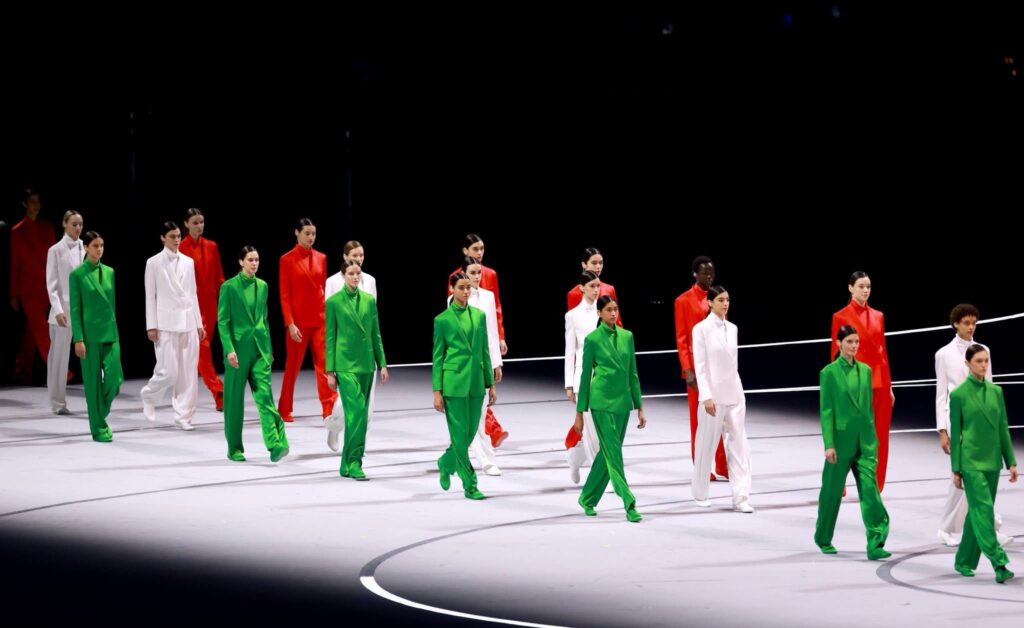
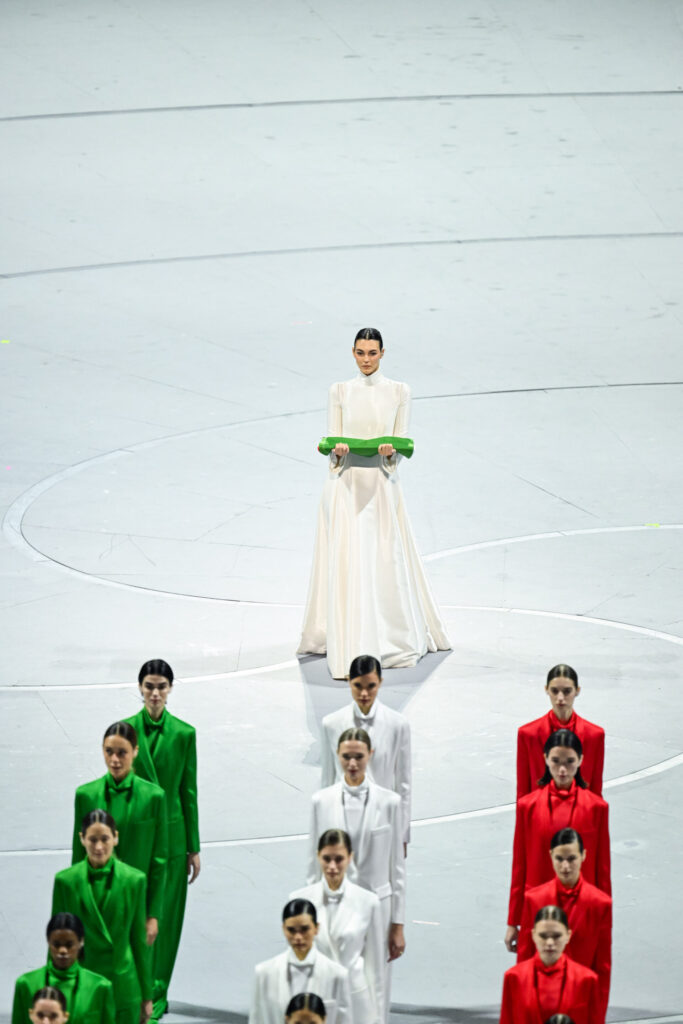
The sartorial elegance of “Re Giorgio” (King Giorgio) was on display during the Olympic ritual of the handing over of the flag to the honor guard. Around 60 models wearing monochrome Giorgio Armani pantsuits in the colors of the Italian flag advanced toward the elite Carabinieri unit, the Reggimento Corazzieri, the ceremonial guard of the Italian Presidency.
This solemn procession in vibrant colors was led by Vittoria Ceretti, wearing a custom-made Armani Privé dress. An iconic model on the fashion scene and partner of American actor Leonardo DiCaprio, she is also the star ambassador for the latest campaign of the Italian fashion house, founded in 1975. Emporio Armani, its more contemporary line, provided the outfits for the Italian athletes. Some commentators were quick to draw comparisons with the 2006 Turin Olympics, where Italian model Carla Bruni also carried the Italian flag and wore a similar, even more elaborate creation.
Many of the artists present at the opening ceremony wore outfits from the Armani ecosystem, such as Laura Pausini in Giorgio Armani Privé, pianist Lang Lang, and concert singer Cecilia Bartoli in Giorgio Armani.
Other Italian brands with a strong presence at the ceremony included Moncler, which, in addition to the Brazilian athletes’ outfits, was behind the silver down jacket worn by the first figure announcing each delegation, Roberto Cavalli for Mariah Carey’s dress, and Emilio Pucci (LVMH) for Sabrina Impacciatore’s vintage ski suit.
Living sports legends
Although it was supposed to be a big surprise during the live broadcast, the identity of the two sports legends from the host country who light the Olympic cauldron was ultimately an open secret for this edition.
In Milan, it was 59-year-old alpine skier Alberto Tomba, known as “Tomba la bomba,” holder of three Olympic titles (slalom and giant slalom in Calgary in 1988 and slalom in Albertville in 1992), the third most successful skier in history in terms of number of victories. He was paired with skier Deborah Compagnoni, 55, winner of three Olympic titles (Super-G in Albertville in 1992, giant slalom in Lillehammer in 1994 and giant slalom in Nagano in 1998) and three-time world champion. In Cortina, it was 33-year-old Sofia Goggia, reigning Olympic downhill champion, who had this honor.
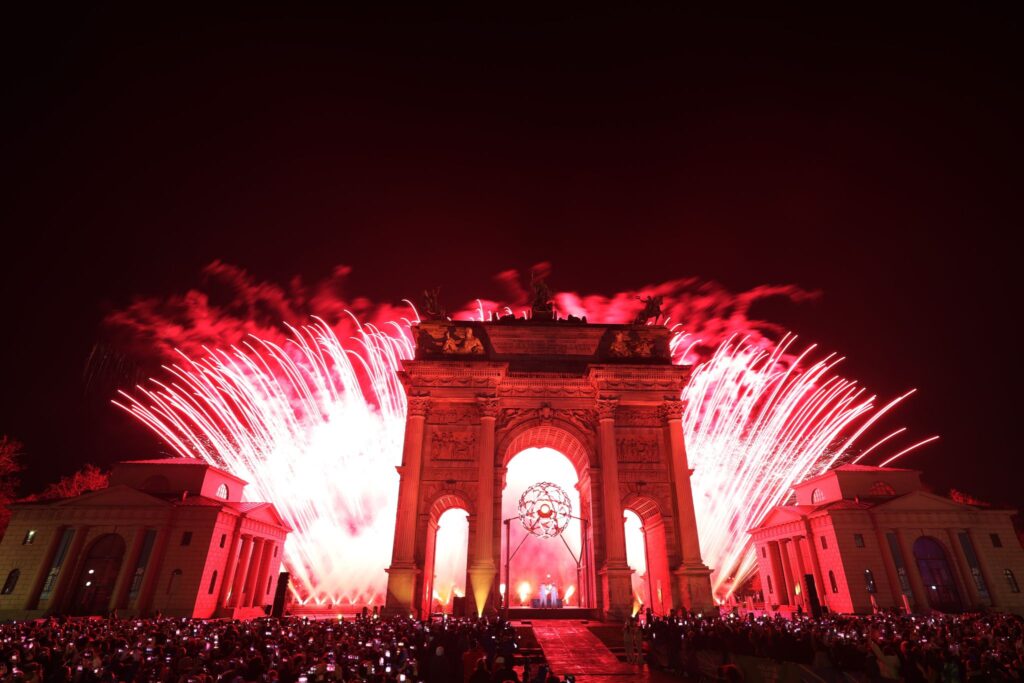
Taking up the concept of Paris 2024, the Italians will be able to gather and celebrate the Olympic Games with two basins or “cauldrons” located in Milan and Cortina. The first is located under the Arco della Pace in Milan, while the second is in Piazza Angelo Dibona in Cortina d’Ampezzo.
A total of 2,900 athletes from 92 countries will compete during the fifteen days of competition. Among the largest delegations for these Winter Games are the United States (293), Canada (210), Italy (196), Germany (189), and Switzerland (175). France has 162 athletes.
The closing ceremony is scheduled to take place in the Roman amphitheater in Verona on February 22. At present, only Milan’s La Scala principal dancer Roberto Bolle has been confirmed.
Read also > Paris 2024: Thomas Jolly proves he is a beast on the Seine
Featured photo: Elsa/Getty Images