

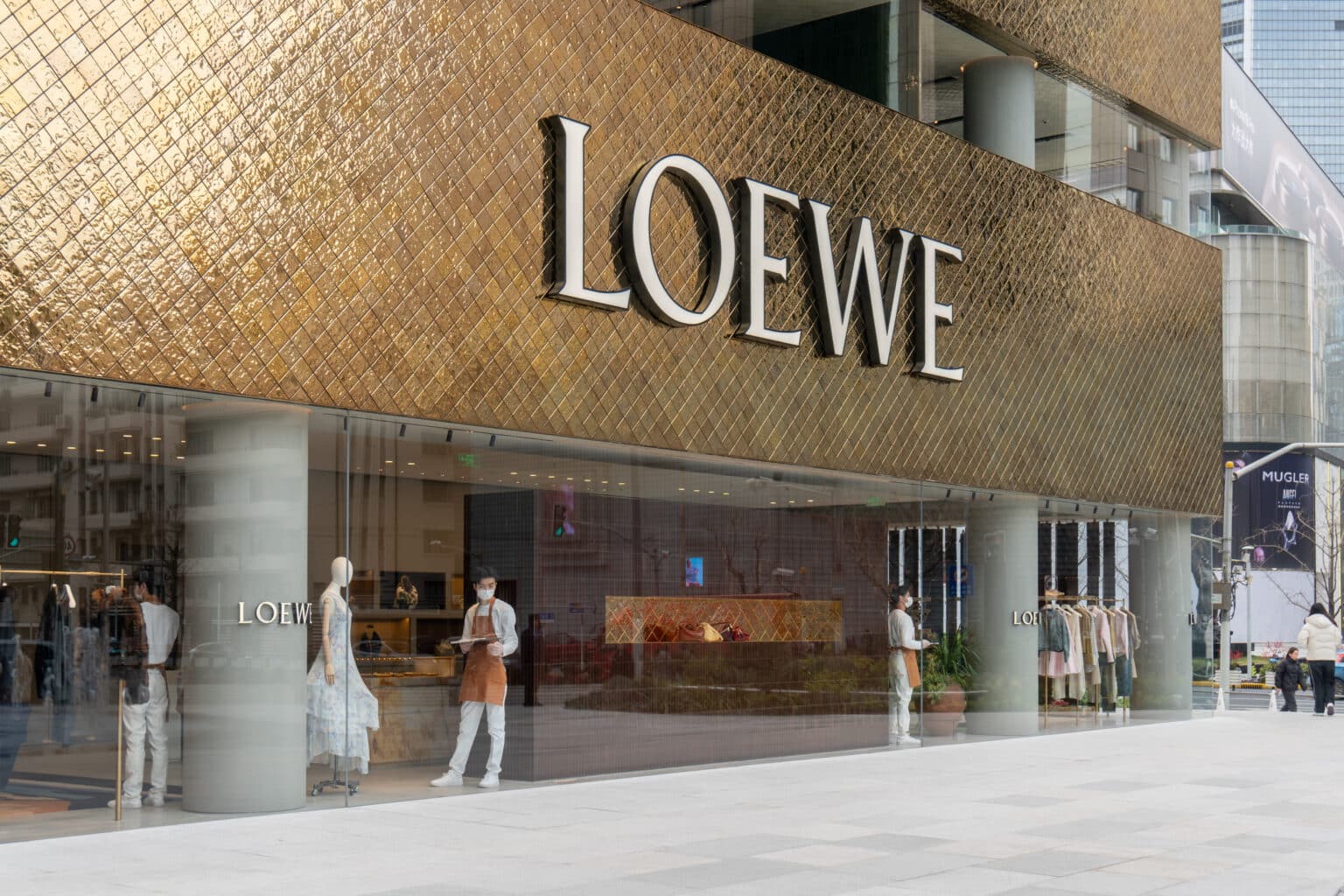


Founded in 1846 by German-born entrepreneur Enrique (Heinrich) Loewe Roessberg, the leather goods house will celebrate its 180th anniversary in 2026. Here’s a look back at the journey of a modest leather workshop that has become an internationally renowned fashion house.
Standing the test of time is no easy feat in the world of fashion and luxury. While Loewe posted a net profit of 157 million euros at the close of its 2024 fiscal year, according to data reported by the Spanish business publication Cinco Días, this internationally renowned fashion house took its first steps as a small workshop specializing in leather goods. Founded in 1846, it is now celebrating its 180th anniversary, making it the second-oldest luxury house in the world.
Promising Beginnings
Let’s head back to 19th-century Madrid. At the time, a German-born entrepreneur named Heinrich (later Enrique) Roessberg Loewe fell in love with Spain. Specializing in leather, he decided to join a group of about a dozen artisans—including carpenters, upholsterers, and lacquerers—and open a modest leather goods workshop on Lobo Street (now Echegaray Street), a bustling thoroughfare in central Madrid.
Voir cette publication sur Instagram
In its early days, this workshop produced small leather goods (wallets, jewelry boxes, toiletries bags…), which were all the rage at the time. Building on this success, in 1892 the company moved to 39 Calle Príncipe, in the heart of the Las Letras neighborhood. At the time, the workshop employed 24 artisans who designed the brand’s first women’s handbags, which helped establish its popularity among high society.
In the early 20th century, Loewe achieved its first major recognition by becoming the official supplier to the Spanish crown and earning the approval of King Alfonso XIII. His wife, Victoria Eugenie of Battenberg, was also a loyal customer of the House. This was followed by nationwide expansion with the opening of two retail locations in Barcelona.
From the Spanish Civil War to Hollywood Glitz
From 1936 to 1939, the Loewe factory—which was nationalized during the Civil War—produced leather goods for military equipment. At the end of the conflict, the House marked a turning point and opened its iconic boutique on Madrid’s Gran Vía, a project entrusted to architect Francisco Ferrer Bartolomé. A few years later, this space underwent a renovation that saw the introduction of storefronts designed by José Pérez de Rozas.
When World War II broke out, Loewe’s reputation was tarnished by Clara Stauffer, the niece of Enrique Loewe Hinton (the son of the brand’s founder).
The daughter of Konrad Stauffer Ruckert, a German entrepreneur in the brewing industry, the young woman—a member of the Women’s Section of the Phalange, a branch of the nationalist men’s organization of the same name—participated in the group’s efforts to strengthen ties between Franco’s Spain and Nazi Germany.
By offering refuge to fugitives, she also helped organize their journey to Argentina. It was against this backdrop that, at the end of the war, the House of Loewe found itself on a blacklist compiled by American and British intelligence agencies. At the time, both countries suspected companies and spies of having collaborated with, financed, or supplied goods to Adolf Hitler’s regime.
To recover from this dark period, Loewe decided to reach out to an emerging North American clientele. During the 1950s, Madrid attracted the era’s most fashionable figures. Legend even has it that the famous writer Ernest Hemingway gave a Loewe bag to actress Ava Gardner. The guestbook from the Gran Vía boutique, preserved in the brand’s archives, bears witness to the visits of illustrious royal clients, such as Princess Grace of Monaco and the Duchess of Windsor, Wallis Simpson, as well as Hollywood actresses like Marlene Dietrich, Rita Hayworth, Elizabeth Taylor, and Sophia Loren.
The Jonathan Anderson Era
Under the leadership of Enrique Loewe Knappe, who passed away ten years ago, Loewe expanded its influence internationally. In 1963, a boutique opened in London and the brand’s first women’s ready-to-wear collection was launched. Nearly ten years later, the brand’s first fragrance was launched under the name “L de Loewe.” Next, it was Tokyo’s turn, followed by 30 other locations across Asia, to discover the Spanish brand’s craftsmanship. It was also during this period that the current anagram was designed by Vicente Vela.
Voir cette publication sur Instagram
In 1983, the House ventured into men’s fashion. Continuing its expansion, Loewe joined the ranks of luxury giant LVMH in 1996. The 21st century marked a new turning point for the leather goods house thanks to the era of Jonathan Anderson, a British designer who arrived in 2013 and gave the brand a viral boost until his departure in March 2025. Under his creative direction, Loewe enjoyed a string of successes with the launch of the iconic Puzzle bag in 2015, the Elephant bag in 2017, and the Egg pumps and Arum bustier.
For more than 10 years, his vision—straddling art, poetry, and elegance—was enough to surpass even the most prominent brands, such as Miu Miu, in Lyst’s ranking of the most-searched-for fashion brands, as seen in the first quarter of 2025. His runway shows were also among the most sought-after on the Paris Fashion Week calendar. Following his departure, Loewe entered a new creative phase with the arrival of the duo Jack McCollough and Lazaro Hernandez.
Read more > How to choose a timeless luxury bag: materials, design, and care
Featured Photo: © Getty Images