







In recent days, the term ‘alpine divorce’ has become viral on social networks. Videos of abandoned or neglected women in the mountains during a hike flood the platforms, revealing more than problematic male behavior.
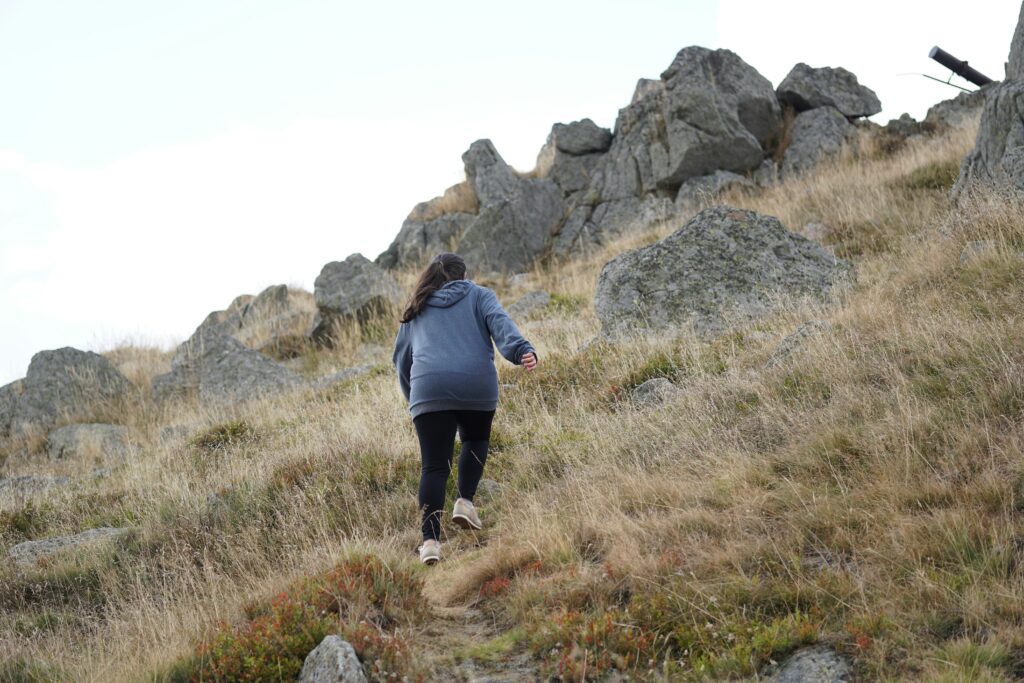
The testimonies follow one another and gather around a common point: during a hike in the mountains as a couple, women are abandoned, neglected or neglected by their partner, often on the pretext of their slowness or a difference in physical condition. If the anecdotes could have remained at bad personal memories, many women tell the same situation and describe a shared feeling.
On a TikTok video, one can see an American woman filming herself alone while walking in the mountains. Her man, he walks much faster, leaving her behind. The legend puts the words on the feeling of these walkers: “You are going to hike with him in the mountains but he leaves you all alone, and you realize that he never really loved you.”
Walk like me and shut up
Far from being an isolated case, the content gathered many comments and ‘I like’. A mass of women mobilized to support the American and tell a similar story. With millions of views, 3.6 million likes, nearly 20,000 comments and more than 130,000 shares, the video has become viral and brings out a very particular hashtag: le divorce alpin, or alpine divorce in English.
@everafteriya #venting ♬ levitation – Aaron Hibell & Felsmann + Tiley
The term finds its origin in a 19th century short story by the Scottish author Robert Barr, “A divorce in the mountains”. It tells the story of a man unable to divorce legally and planning to kill his wife during a trip to the Swiss Alps.
This phenomenon is considered as symptomatic of a power imbalance in relationships, where the woman, when deemed not performing enough, is simply put aside. The observation is clear: one should – in addition to being effective at work, be an excellent mother, be a domestic faerie, organize and plan daily life and vacations, and remain perfect in their relationship – have the physical condition equivalent to his +1 to go on a dynamic hike of several hours. And of course, without complaining or asking to slow down the pace so that it suits the two protagonists of the outing.
According to a study by the NGO Make Mothers Matter, conducted in partnership with Kantar and unveiled in 2025, 67% of mothers interviewed in Europe said they were exhausted by the mental load. The result is a general malaise and a feeling of never being up to it and good nowhere.
The ‘alpine divorce’: a psychological violence
On Reddit, Twitter and Threads, people comment on the ‘alpine divorce’ as revealing a broader relational dynamic, where domination, control or emotional abandonment are described as forms of psychological violence. Women are often those who feel left behind or belittled during ‘sports’ or ‘adventurous’ outings. Several commentators believe that even if these stories do not result in physical dramas, they reflect a form of humiliation, punishment, control and lack of empathy that can be interpreted as a type of gendered violence in relationships. Not to mention the security aspect.
A news item that also fueled the debate. In February 2026, a 37-year-old man was sentenced in Austria to five months of suspended prison for having left his partner alone in the mountains, where she succumbed to hypothermia after being abandoned in conditions deemed dangerous. If the Austrian justice qualified the facts as manslaughter by aggravated negligence, the case was nevertheless perceived by some observers as a tragic echo to the expression of “alpine divorce” and to the symbolic or latent violence that it implies.
The virality of the term is therefore part of a social context where issues of violence against women, mental load, inequalities and sexist behaviors are highly debated in French-speaking and international media, and increasingly weigh on society.

Some commentators link this phenomenon to the rise of masculinist currents. Recently described by political figures as a movement that perceives gender equality as a threat, it opposes anti-violence measures, notably through campaigns aimed at disrupting the lines of aid for victims.
Read also : Younger generations are increasingly less interested in married life
Featured photo : Unsplash