


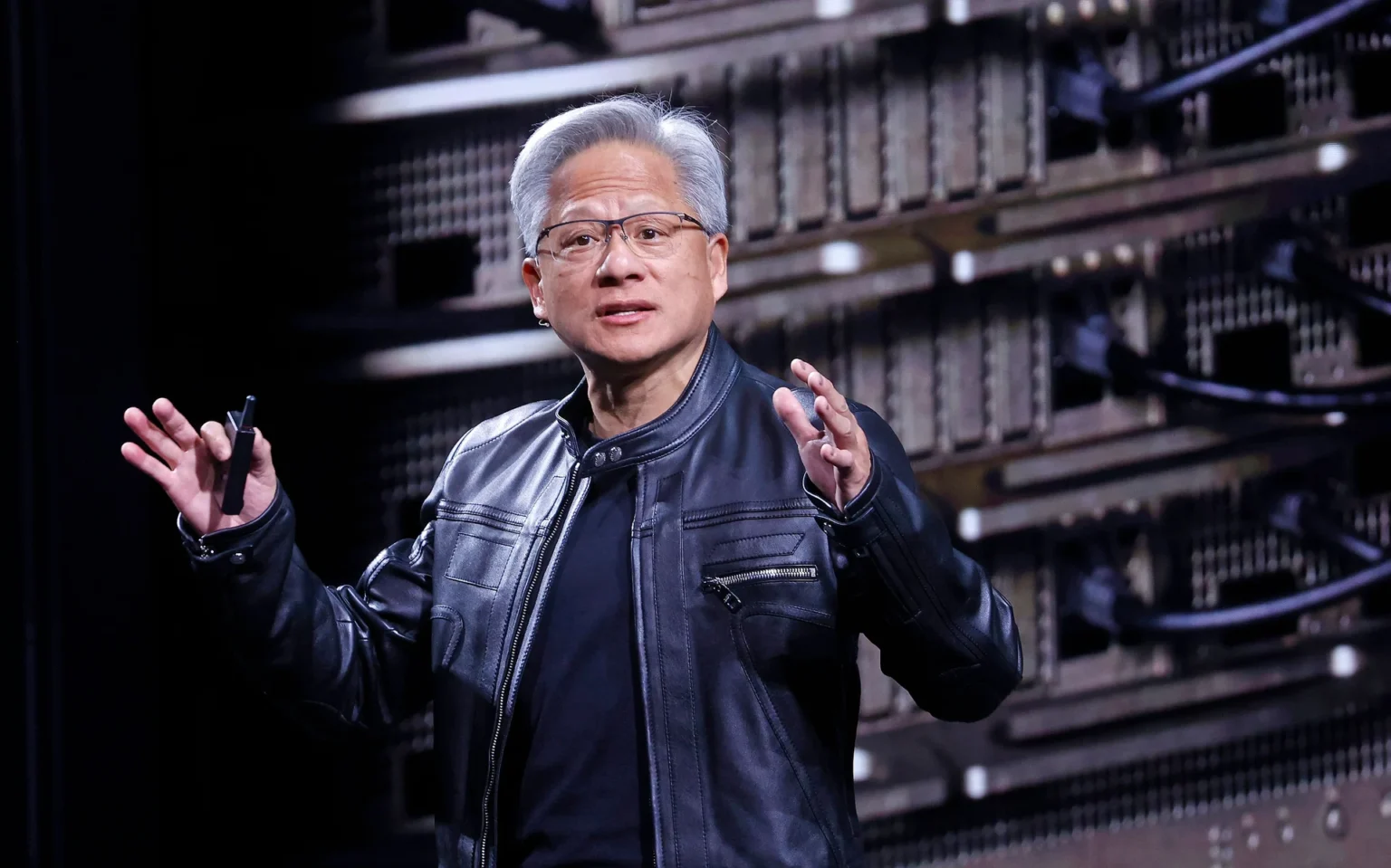




CEO of Nvidia, the world leader in electronic chips, Jensen Huang is not only one of the richest people on the planet, but in recent years he has also become the influential voice of the irresistible rise of artificial intelligence. Elevated to the status of a tech rock star and adored wherever he goes, his aura extends beyond the geek community, while his personal journey fuels the flourishing narrative of hustle culture, where endurance is already a victory.
Wherever he goes, he draws huge crowds, fills stadiums, and brings together a community of fans who will do anything to get their idol’s autograph on books, posters, or even baseballs. This media personality and popular figure is not Taylor Swift, but Jensen Huang, 62, tech boss hailed as the messiah of artificial intelligence, as was the case last June at the Vivatech trade show in Paris.
He was only 30 years old and had a very compact resume (significant experience in tech, all things considered) when he founded his own company specializing in semiconductor manufacturing, Nvidia.
Although he started out in the geeky, niche world of video games, the AI boom in 2024 will make his fortune to the point where he have run the most valuable company in the world in 2024 and became the driving force behind American sovereignty in new technologies.
A daring Taiwanese-American
The man then known as Jen Hsun was born in Tainan, the former capital of the island of Taiwan, on February 17, 1963. In this middle-class family, his father was a chemical engineer at an oil refinery and his mother was a teacher.
At the age of five, he left his native country for Thailand. Shortly before he turned ten, as the Vietnam War broke out on the border, his parents decided to send him and his brother to the United States.
The two brothers were entrusted to an uncle in Washington State. Accidentally, he ended up at Oneida Baptist Institute, a religious academy for troubled boys in Kentucky, which his uncle mistakenly thought was a prestigious institution. It was a difficult time, during which the young Jensen Huang had to quickly learn English, work on a tobacco farm, clean toilets, and, above all, fit in. He befriended a 17-year-old ex-convict who taught him self-defense while Jensen Huang taught him math.
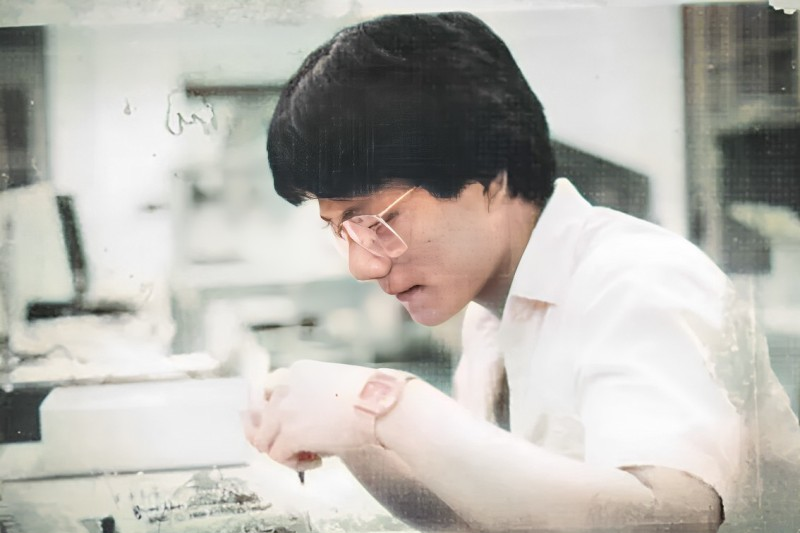
A few years later, he would write one of the only two lines that make up his legendary LinkedIn resume, becoming a “dishwasher, busboy, and server” at Denny’s, a fast-food chain, to finance his studies. There, he once again found himself cleaning toilets. This experience, although particularly harsh, forged his character and instilled in him the importance of discipline and hard work. His parents eventually joined him in the United States two years later, and he went to live with them in Oregon. Jensen Huang also worked other odd jobs to finance his studies, including at a company that manufactured industrial microwaves.
Despite these challenges, he persevered and eventually earned a degree in electrical engineering from Oregon State University in 1984. He was 21 years old at the time.
It was at this institution that he befriended his lab partner, Lori Mills, who would become his wife five years after they met. Jensen Huang was then able to begin his professional career as a microchip designer in Silicon Valley. He was approached by Texas Instrument, LSI Logic, and Advanced Micro Devices (AMD).
He ultimately chose the third option, the American semiconductor giant based in Santa Clara, California. His experience at AMD allowed him to contribute to the design of microprocessors and gain significant experience in the semiconductor industry. At the same time, he took evening classes at the prestigious Stanford University and, eight years later, earned his master’s degree in electrical engineering.
He then joined LSI Logic, a fast-growing start-up that had wanted to recruit him a few years earlier. There, he learned to master the intricacies of custom semiconductors and ASIC technology, honing his skills in large-scale integration and pushing the boundaries of electronic chip design ever further.
Nvidia, a visionary project
In 1993, he co-founded his own company, Nvidia, with two of his friends, Chris Malachowsky and Curtis Priem. With $600 in seed funding (200 from his lawyer and 200 from each of his co-founders), this new company aimed primarily to solve the problem of 3D graphics in PC games. The business plan was drawn up at a table in a restaurant belonging to the Denny’s fast food chain. This choice was motivated not only by Jensen Huang’s previous experience as a waiter, but also because the coffee was cheap.
His idea proved to be particularly visionary: graphics processors or GPUs were not only intended for PC video games, they could revolutionize computer processing.
With this idea in mind, two years after its founding, the company launched its first product, the NV1. As the first chip to combine audio, video, and 3D graphics, Jensen Huang wanted to transform a personal computer into a “PC video game console” and thus compete with the consoles of the time (Sony’s PlayStation, Sega Saturn, and Nintendo’s Ultra 64). But above all, the product offered an optimized 3D architecture that challenged the standards of the video game industry. This ambitious project made the mistake of targeting a particularly limited niche market. It proved to be a commercial failure with only two major customers, Sega and Diamond Multimedia. It wasn’t enough to revolutionize the market, which posed compatibility issues: the company was on the verge of bankruptcy.
Nvidia had less than nine months of autonomy and had to write off three years of hard work and nearly $20 million previously spent on R&D.
Jensen Huang then took a gamble, investing his remaining resources in the development of a second product, the RIVA 128. This time, he did not hesitate to abandon the initial architecture of the project and return to a simple idea: to deliver a product adapted to market standards and needs, inspired by the then-leader Microsoft Direct3D, while offering better performance. By creating three development teams, each working according to the 18-month innovation cycle in force on the market but staggered by six months, Jensen Huang found a way to develop a product and bring it to market at lightning speed.
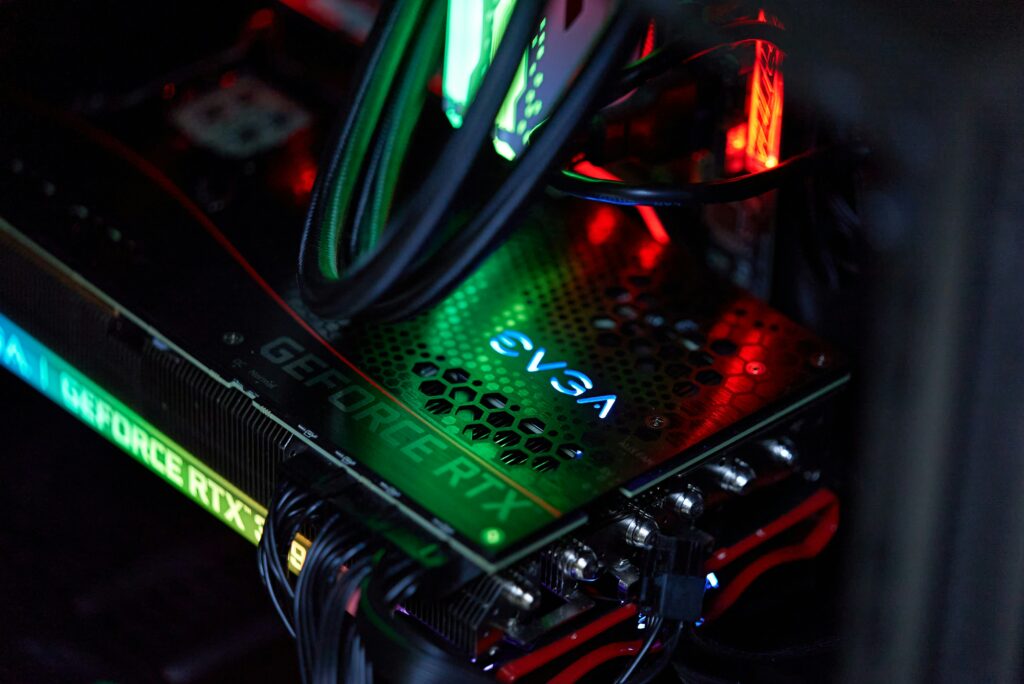
This decision paid off, and in 1999, the company revolutionized the market with the first true GPU in history, the GeForce 256. Propelled to the top, Nvidia went public on January 22, 1999, at a price of $12 per share.
Legendary Pivot
In 2006, Nvidia developed CUDA (Compute Unified Device Architecture). This new programming language and framework harnessed the full power of GPUs for uses far beyond video games.
Researchers then began to repurpose GPUs for deep learning—a branch of artificial intelligence that allows a computer to learn on its own from data—scientific simulation, and quantitative finance. A GPU is capable of performing thousands of operations in parallel, making it much faster than conventional solutions.
The breakthrough came in 2012. At the ImageNet competition, the AlexNet model developed by Hinton, Krizhevsky, and Sutskever broke all image recognition records and proved to be trained on Nvidia GPUs (GTX 580). This success proved that deep learning is simply impossible without GPUs. Jensen Huang then realized that the chips manufactured by Nvidia were the ideal infrastructure for AI.
Starting in 2016, Nvidia developed GPUs dedicated to AI. The company then marketed Tesla/Volta (V100), followed by Ampere (A100) and Hopper (H100).
However, it wasn’t until 2022 and the launch of ChatGPT’s generative artificial intelligence that the use of AI became widespread.
In 2023, the company joined the very exclusive club of neo-GAFAM, the Magnificent Seven, the most highly valued and active technology companies in artificial intelligence alongside Microsoft, Tesla, Meta, Apple, Alphabet, and Amazon.
In 2024, the explosion in demand for AI architectures, coupled with the promises of gains made by consulting firms and Open AI, itself a customer of Nvidia chips, quadrupled its valuation, even reversing the balance of power with Microsoft and Apple. In January 2025, China’s unveiling of Deepseek, a new language model offering the same services as ChatGPT at a fraction of its price and energy cost, caused Nvidia’s stock to plummet by $590 billion, the biggest stock market shock to date.
In July 2025, Nvidia became the first publicly traded company in the world to exceed $4 trillion in market capitalization (approximately €3.7 trillion). According to Reuters, Nvidia then represented 7.3% of the S&P 500 (the index of the 500 most valuable US companies). With 22% growth between January and July, Jensen Huang’s company outperformed the entire semiconductor sector, including competitors such as AMD, Intel, and Qualcomm.
Having become a key player in the AI ecosystem (with a 90% market share in AI chips), Nvidia is increasing its strategic partnerships and investments in innovative third-party companies. In September, the company committed to investing $100 billion in OpenAI in exchange for equipment from Jensen Huang’s company. The stated goal is to deploy unprecedented computing power: 10 gigawatts, equivalent to 4 to 5 million GPUs (which the company plans to deliver in 2025), according to the CEO speaking on CNBC. At the same time, Nvidia has invested $5 billion for a 4% stake in Intel and $700 million in British start-up Nscale.
Tech rock star
The whole success story of Nvidia and the fortune of Jensen Huang, estimated by Forbes at $125 billion, is fueling a wave of fascination that transcends the tech world.
Founder Jensen Huang enjoys an extraordinary aura, especially since his main rival in the tech rock star clan, Elon Musk, has seen his image severely tarnished by successive scandals and his brief stint in the Trump administration. Whereas the CEO of Tesla, X (formerly Twitter), Space X, and other companies has been the subject of much criticism for his toxic management style and sudden mass layoffs, Jensen Huang says he hates firing people. “Rather than firing someone, I prefer to torture them into becoming good,” the Nvidia boss said, not without humor.
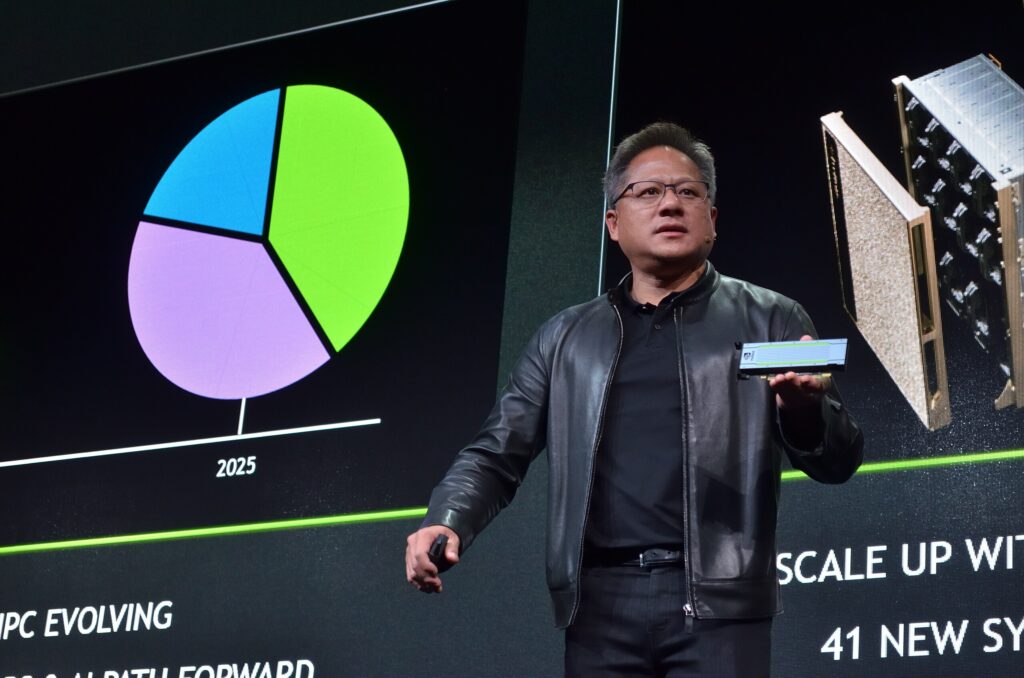
Jensen Huang may be a global billionaire and an influential figure in tech and AI, but he cultivates a relatively accessible and benevolent image that contrasts with the successful entrepreneurs of the 2010s.
Mark Zuckerberg himself has dubbed him “the Taylor Swift of Tech.” But while he stands out from his Silicon Valley peers with his philosophy, the Nvidia boss hasn’t forgotten the winning formulas, particularly the art of the uniform, both to stand out and to reduce his daily mental load. In two decades, the tech boss has never taken off his black leather jacket. So much so that Jensen Huang likes to describe himself as “the man in the leather jacket who repeats the same thing three times.”
If Zuckerberg dares to compare him to the pop megastar, it’s because each of his appearances, whether at Computex Taiwan or last spring at Vivatech, causes crowds to gather and euphoria to erupt to such an extent that his security team is often on high alert. People jostle for his autographs. Some are even willing, in an almost mystical logic, to acquire the famous jacket of the successful entrepreneur, which they imagine to be a lucky charm. As the price of fame, counterfeits are circulating online under the name “Jensen Huang Leather Jacket.”
Like Taylor Swift, he also has a community of fans. For him, on TikTok as on Instagram, instead of Swifties, he can count on Jensanity. These loyal admirers do not hesitate to perpetuate the legend of Jensen Huang’s unwavering perseverance, making mini videos from his speeches and tracking down inspiring punchlines to turn them into quotes to ponder. Jensen Huang once said, “To survive in a highly competitive industry, you have to want it more than anyone else. As a company, team, and entrepreneur, you have to want to succeed more than your competitors want to stop you… My will to survive exceeds that of almost everyone who wants me to fail.”
It remains to be seen whether his popularity will last as artificial intelligence approaches Gartner’s hype cycle, a painful but unavoidable stage before the widespread adoption of any technological innovation. The company’s rapid growth does not sidestep the question of the validity and viability of its stock market value. The situation is all the more geopolitically unstable given that the company that supplies it with raw materials, TSMC (63% market share in the latest generation chip foundry), is Taiwanese and under threat of annexation by China.
Read also > Artificial intelligence (AI) is now regulated in California
Featured photo: © Getty Images