

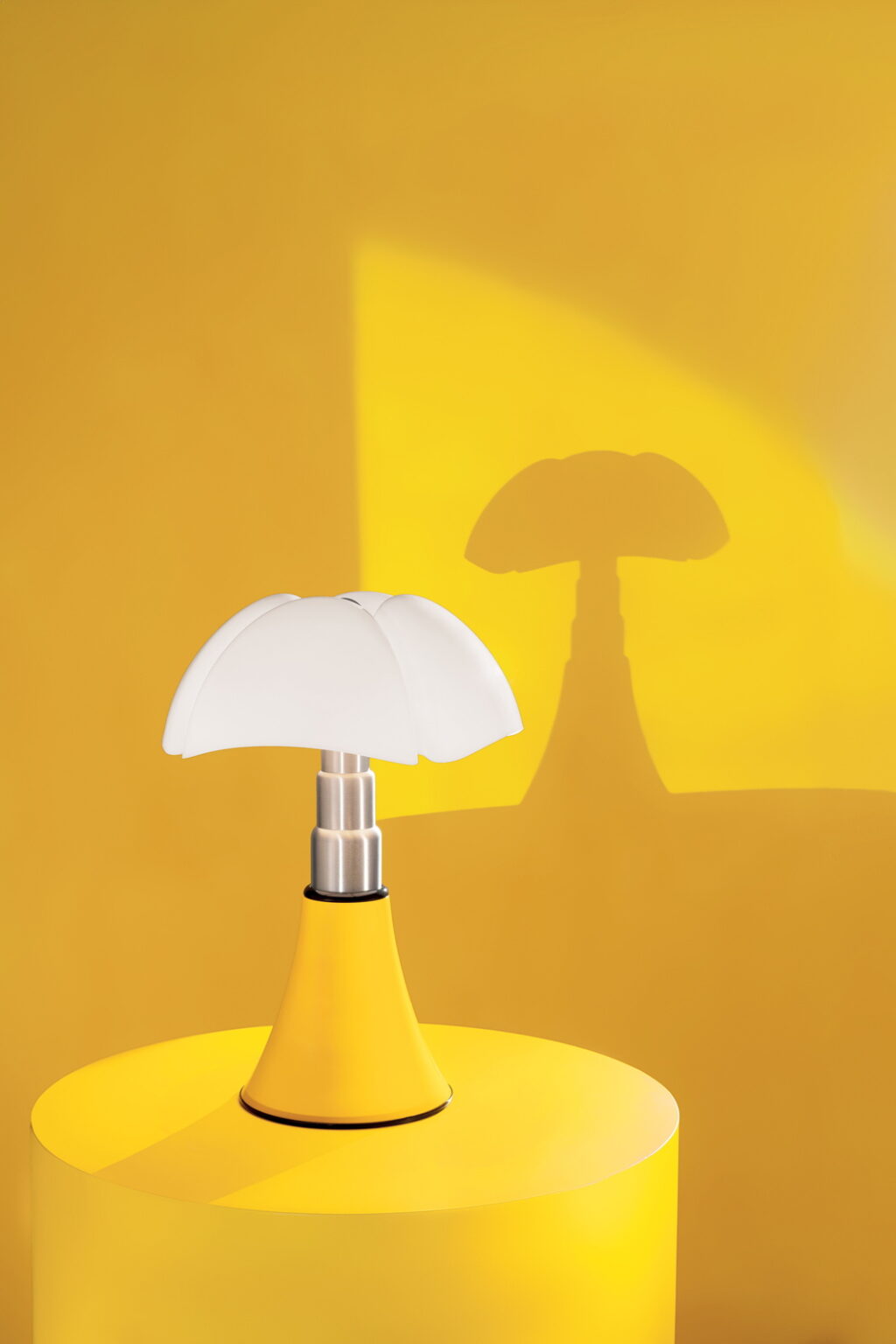




Since its creation in 1965, the Pipistrello lamp by Italian architect and designer Gae Aulenti has become much more than just a light fixture: it is a symbol of modern design history and a sought-after piece in interiors around the world. Combining technical innovation, sculptural sensibility, and organic expression, it embodies the inventive spirit of post-war Italy and continues to illuminate spaces as a timeless object.
1965: a commission for Olivetti and a lamp that “makes architecture”
In the 1960s, Italy was at the center of a veritable creative revolution. After the severe rationalism of the post-war period, a generation of designers sought to explore more expressive and sensitive forms. Gae Aulenti was fully in line with this trend.
From her earliest sketches, Aulenti wanted this lamp to evoke the fluidity and movement of nature: a living object rather than a simple functional device. It is not a random shape, but an organic design inspired by the observation of natural forms, a way of combining art, nature, and technology in a single object.

The Pipistrello was created in 1965 by Gae Aulenti in a very specific context: the design of Olivetti showrooms, particularly in Paris (and also in Buenos Aires, according to the publisher). The idea was not to place “a pretty lamp” in a corner, but to create an object capable of participating in the space: present, sculptural, and yet useful in everyday life.
From the outset, the Pipistrello blurred categories: neither really a table lamp nor quite a floor lamp, its height varies and it can be placed on the floor or on a piece of furniture. Le Mag du Monde sums up this uniqueness very well: it “flutters” from one place to another, changing its role depending on the room and its use.
Its silhouette: a bat… and a hint of Art Nouveau
Its name says it all: pipistrello means bat in Italian, and the lampshade evokes outstretched wings. But the inspiration doesn’t stop at the animal reference. Several sources point out that the lamp contrasts with the strict rationalism of the 1960s: rounded curves, sensual volumes, a sort of return to decoration—often likened to the Art Nouveau spirit, but translated into industrial language.
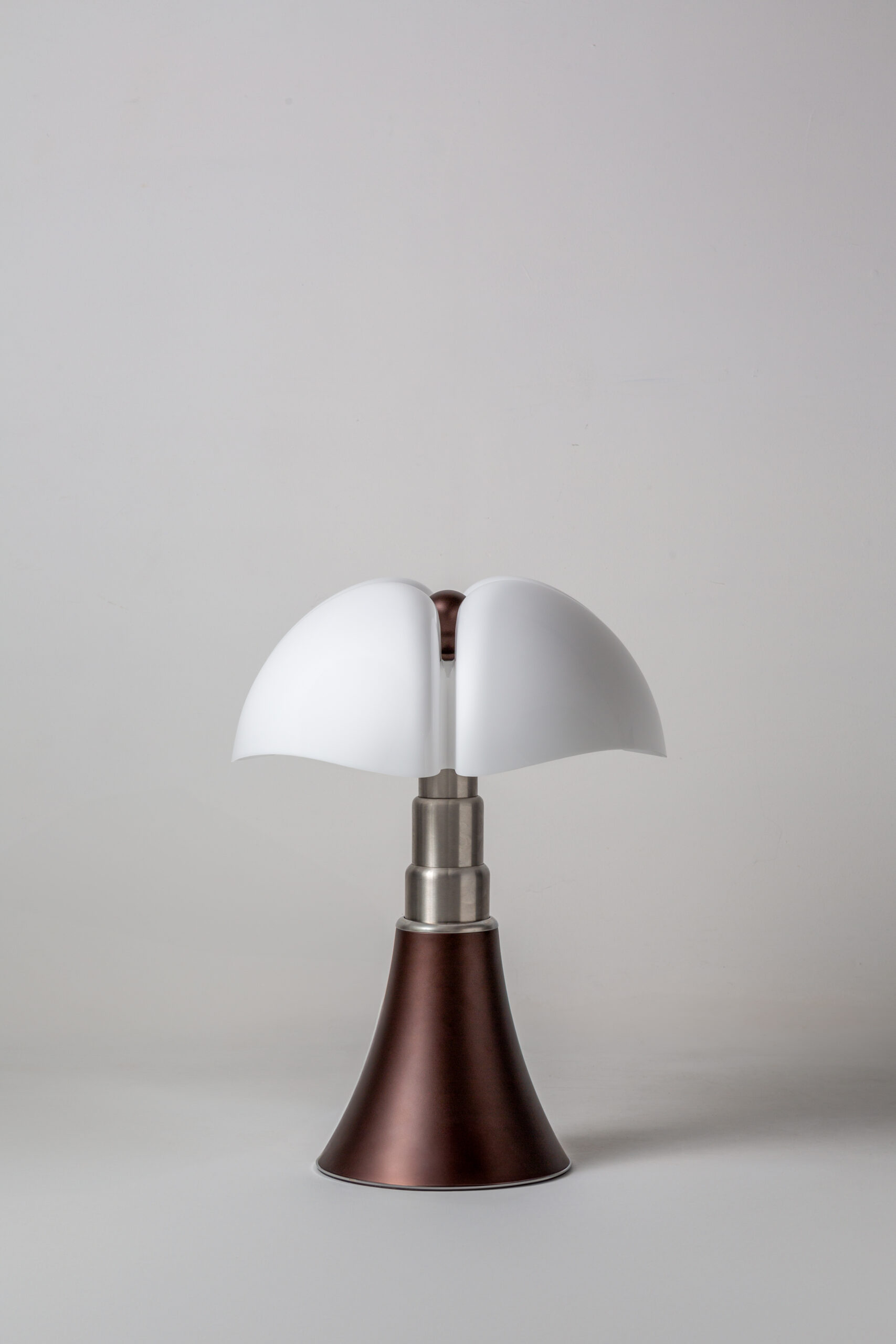
Visually, it’s all about contrast: a very stable conical base, an almost technical telescopic rod, and at the top, a soft opal “corolla” that transforms the light into a halo. The Pipistrello lamp is a construction set consisting of a telescopic metal tube in satin-finish stainless steel that allows the lamp to be raised from 66 cm to 86 cm in height, a painted aluminum base, and a rigid shade in opalescent white methacrylate with a diameter of 55 cm.
When the technology of the time slows down… then liberates the idea
One of the most telling anecdotes, because it is told by the publisher himself, can be summed up in one sentence: the concept was so ambitious that the technology of the time was “not yet mature.” The telescopic mechanism and the complex shape of the diffuser posed real manufacturing challenges.
This is where Elio Martinelli, founder of Martinelli Luce, a company that at the time wanted to renew its range of lighting fixtures by incorporating avant-garde designs, came into the picture. Recognized as a pioneer in methacrylate molding (the opalescent plastic that would become the signature of the lampshade), the manufacturer recounts a series of trials and research efforts before finding an industrial solution. Indeed, the manufacturing techniques available at the time did not yet allow for the mass production of the original opaline methacrylate lampshade combined with a telescopic structure, a bold innovation for the time.
In 1967, two years after its design, the Pipistrello was finally launched. Despite a modest introduction to the market, it quickly became a cult object.
Short stories: notebook, sleepless nights, and a “stripped-down” lamp
Among the anecdotes that often come up, there is one particularly delightful one, documented by IDEAT: in 1965, Aulenti presented her project, “drawn on a sheet of notebook paper,” to Elio Martinelli, who immediately responded with a “yes.”
IDEAT also reports a memory passed on by Emiliana Martinelli (Elio’s daughter): her father carried out numerous tests and spent “sleepless nights” experimenting with methacrylate and light diffusion. She recalls tests carried out with a “stripped down” Pipistrello to remain faithful to the original design.
Finally, Sergio Camilli (founder of Poltronova) suggested that Gae Aulenti contact Martinelli to solve the technical challenge.
A “nomadic” design ahead of its time: Pipistrello: the lamp that redefined light
If the Pipistrello has stood the test of time, it is not only because of its iconic silhouette: it is also because it anticipates our modern uses thanks to very contemporary features such as adjustable height (approximately 66 to 86 cm), four light sources under the shade, providing powerful light softened by opal, recent technical developments with the switch to LEDs, and even a model allowing the intensity to be varied, which appeared in 2020.
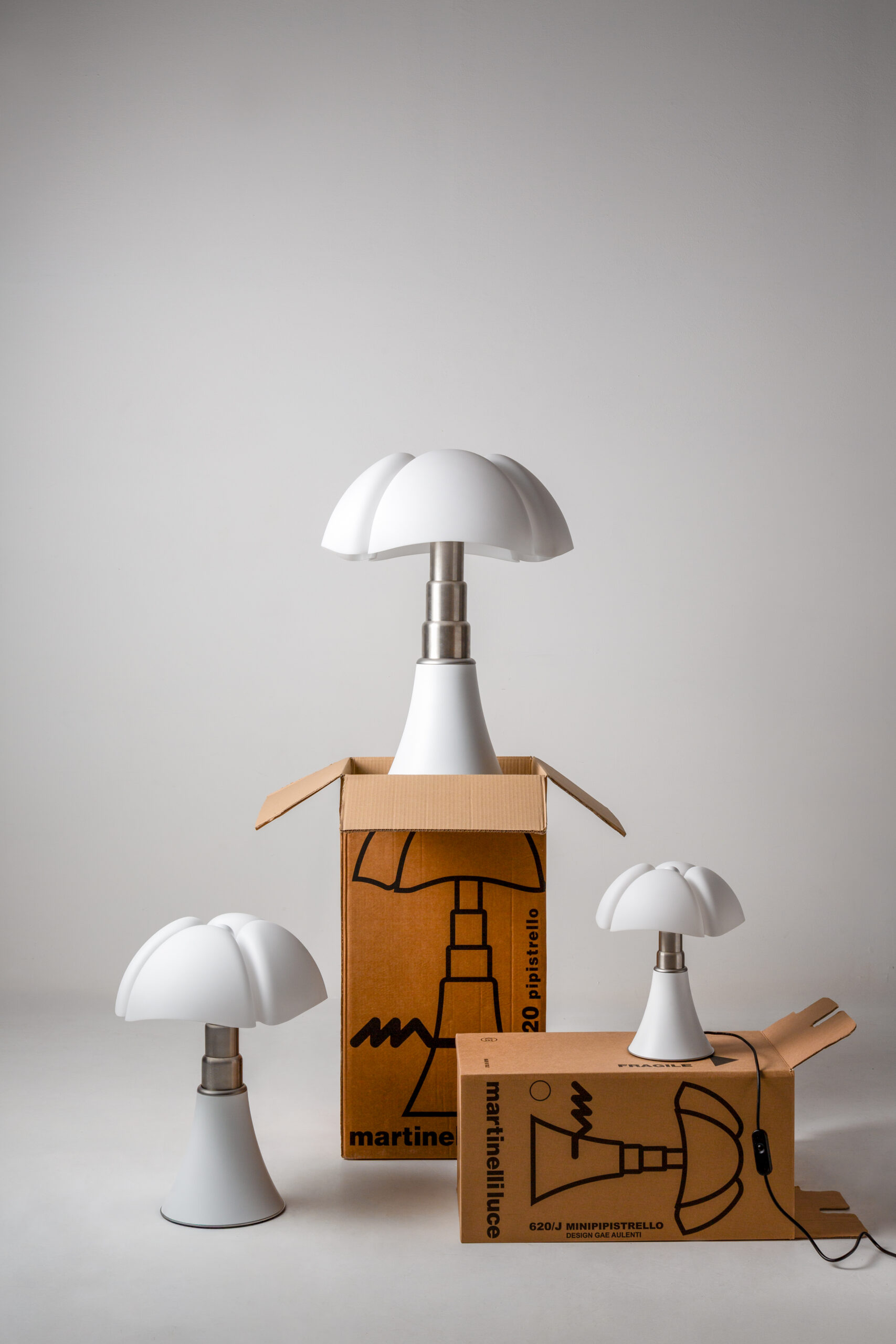
In terms of style, the Pipistrello has evolved without ever compromising its identity. Initially available in brown, its base has been produced over time in a rich palette of finishes and colors, including recent anniversary editions—such as a matte white version launched in 2025 to mark its 60th anniversary. Both essential and sophisticated, white enhances the purity of the Pipistrello’s iconic lines, while reaffirming the modernity of its timeless beauty.
Recognition and heritage: the museum piece
Gae Aulenti (1927–2012) was a major figure in Italian architecture and design. Her work, often characterized by an ability to combine tradition and modernity, helped define Italian design in the mid-20th century.
The Pipistrello is undoubtedly her most accessible work to the general public, a bridge between architectural discipline and domestic design, between utility and poetry.
The Pipistrello has not only found its place in private interiors and designer hotels: it has entered the permanent collections of international museums, including the Museum of Modern Art (MoMA) in New York, proof of its cultural and artistic value.
It has also been exhibited in major retrospectives devoted to 20th-century Italian design, confirming its place as one of the major successes of the post-modern era.
When the Pipistrello meets cinema
Beyond the world of design, the Pipistrello has even crossed the boundaries of the seventh art. It can be seen incorporated into the set design of the film Pain and Glory (Dolor y gloria) directed by Pedro Almodóvar in 2019, where it appears in the main character’s apartment.
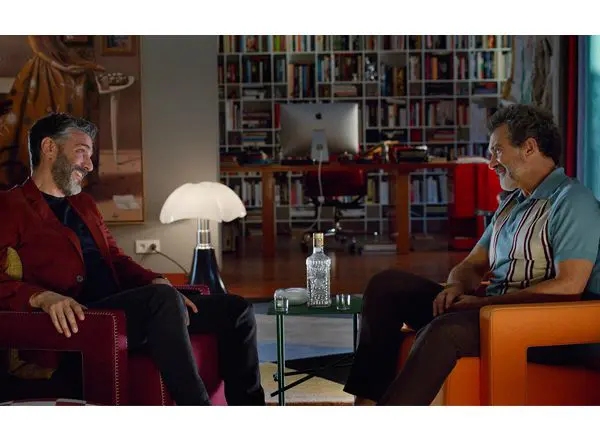
This appearance is not insignificant: Almodóvar, a filmmaker known for his attention to visual detail, often uses iconic design objects in his sets. The presence of the Pipistrello in the film highlights both a strong aesthetic taste and the lamp’s ability to blend into rich narrative worlds.
Another perfect nod: the Pipistrello appears in The Batman (2022) movie —notably in the Penguin’s world, at the Iceberg Lounge—a cameo (brief appearance) that is almost too obvious for a “bat” of design.

More than 60 years after its creation, the Pipistrello remains an essential reference in industrial design. Its unique silhouette, its subtle relationship with light, and its ability to transcend eras and styles make it a piece that continues to illuminate not only rooms, but also the history of contemporary design. It is a living testament to innovation, creativity, and timeless elegance—one of those rare objects that, like the films in which they appear, remain etched in our imagination.
Read also > The little stories of… The Toile de Jouy fabric
Featured photo: © Martinelli Luce