






Gifted by France to the United States in 1886, the Statue of Liberty has, over time, become much more than just a monument; it has come to symbolize a diplomatic relationship spanning 250 years. Behind this iconic figure lies a history that blends politics, innovation, and symbolic evolution.
It all begins in 1865. The American Civil War has just ended and, on the other side of the Atlantic, French jurist Édouard de Laboulaye envisions a powerful gesture: offering the Americans a monument celebrating freedom and democracy.
The project takes shape slowly. It is not until 1871 that sculptor Frédéric Auguste Bartholdi crosses the Atlantic and falls under the spell of New York Bay. The location is obvious. It will be there, facing the ocean, that the statue will stand.
When it is finally unveiled on October 28, 1886, the ambition is to celebrate American independence of 1776, but also to affirm a broader, almost universal idea — that of liberty as a founding value.
A Technical Achievement Worthy of a Modern Construction Site
Behind its apparent simplicity, the Statue of Liberty is a pioneering work of engineering. Built in Paris during the 1870s and completed in 1884, it is composed of thin hammered copper plates fixed onto a metal framework designed by Gustave Eiffel – the same Eiffel who would build his Parisian tower a few years later.
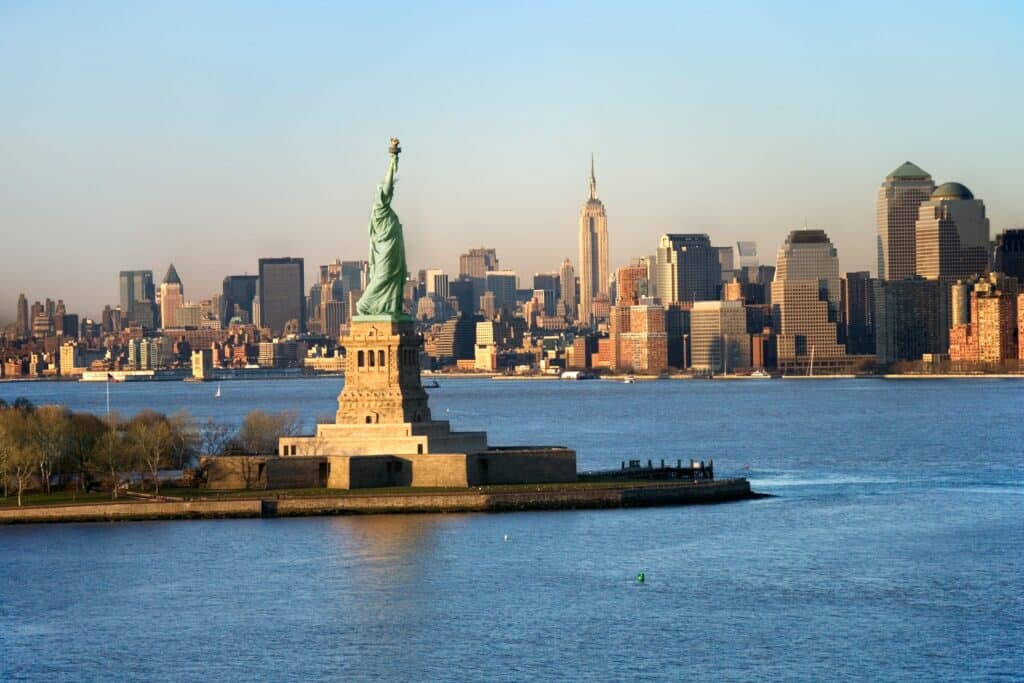
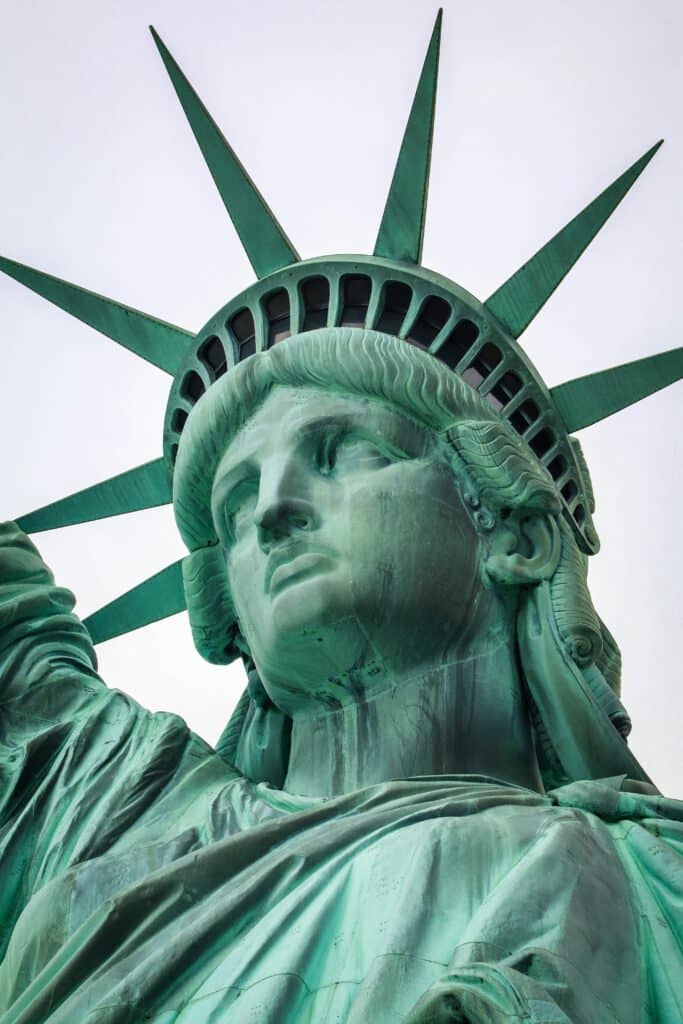
The challenge is immense. As an embodiment of the grandeur of the Belle Époque, this monumental statue had to be capable of withstanding Atlantic winds. The result is a structure that is both solid and flexible — an innovation for its time. In 1885, the statue was dismantled into more than 300 pieces, transported by ship to New York, and then reassembled on its pedestal. A year later, it already dominated the skyline, standing 93 metres tall. And that distinctive green colour? It was never planned. It is the natural oxidation of the copper, beginning in the 1890s, that gave it this now iconic hue.
From Political Symbol to Gateway of the American Dream
Originally, the statue represents Libertas, the Roman goddess of liberty, and may have been inspired by the faces of those close to its creators. Torch raised, gaze turned toward the horizon, she embodies progress and emancipation. At her feet, broken chains serve as a reminder of the end of oppression. While before 1902 the statue served as a lighthouse (though not a particularly effective one), its meaning then shifted.
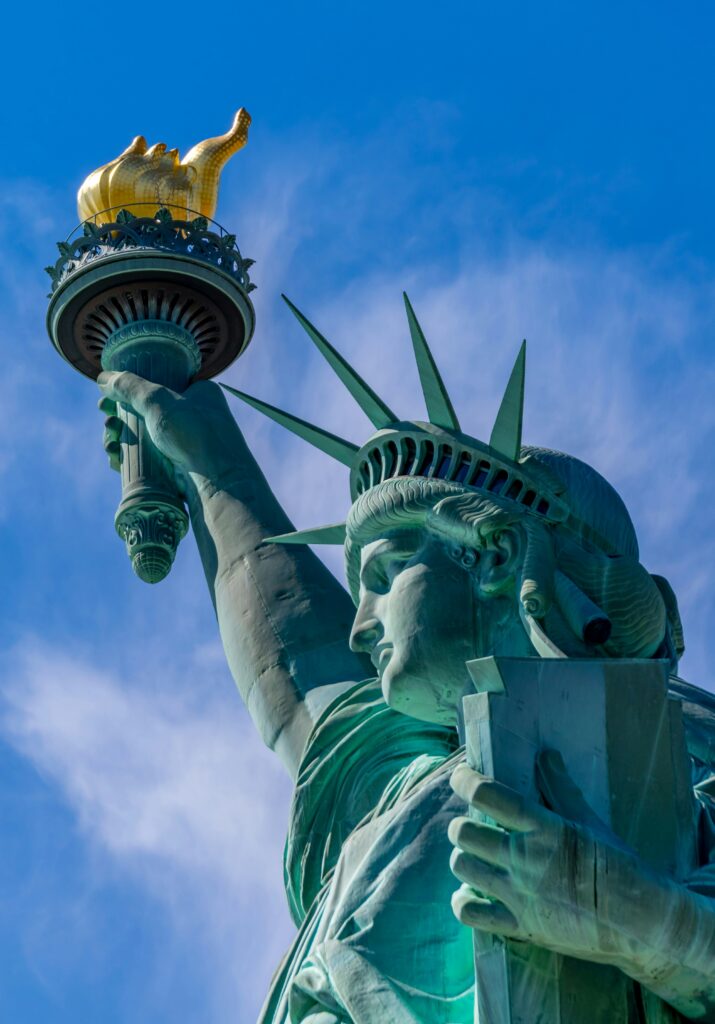
At the end of the 19th century, millions of immigrants arrived in New York. And for many, the Statue of Liberty was their first image of America. It became something else entirely: a promise, deeply rooted in that progressive ideology — the American Dream. In 1903, Emma Lazarus’s poem The New Colossus was engraved on its pedestal:
“Not like the brazen giant of Greek fame, With conquering limbs astride from land to land; Here at our sea-washed, sunset gates shall stand A mighty woman with a torch, whose flame Is the imprisoned lightning, and her name Mother of Exiles. From her beacon-hand Glows world-wide welcome; her mild eyes command The air-bridged harbor that twin cities frame. “Keep, ancient lands, your storied pomp!” cries she With silent lips. “Give me your tired, your poor, Your huddled masses yearning to breathe free, The wretched refuse of your teeming shore. Send these, the homeless, tempest-tost to me, I lift my lamp beside the golden door!”
The message is clear. This monument is not merely a political symbol: it is a call to action, hope cast in metal, an openness to the world and its peoples.
Throughout the 20th century, the statue’s status evolved. Designated a national monument in 1924, then inscribed on the UNESCO World Heritage List in 1984, it gradually became a global, almost universal image. It has been reproduced everywhere: in Paris, on the Île aux Cygnes since 1889, in Tokyo in Odaiba Bay, and in several cities across Europe and America.
A Reinterpreted Emblem Adopted Around the World
The Statue of Liberty is also a cinema star. It appears in disaster films, blockbusters, and historical scenes. It is sometimes destroyed, sometimes idealised, but always charged with meaning.
In Titanic (1997), it briefly appears on the horizon. And this line says it all: “I can see the Statue of Liberty already… very small, of course!” exclaims Jack Dawson’s friend from the deck of the ship.
Today, the Statue of Liberty attracts millions of visitors every year. It remains one of the most recognisable monuments in the world. In a world where questions of immigration, borders, and freedom are at the heart of debate, its message continues to evolve. It is at once celebrated, questioned, and reinterpreted.
Read also : The little story of… K-Beauty
Featured photo : Unsplash