

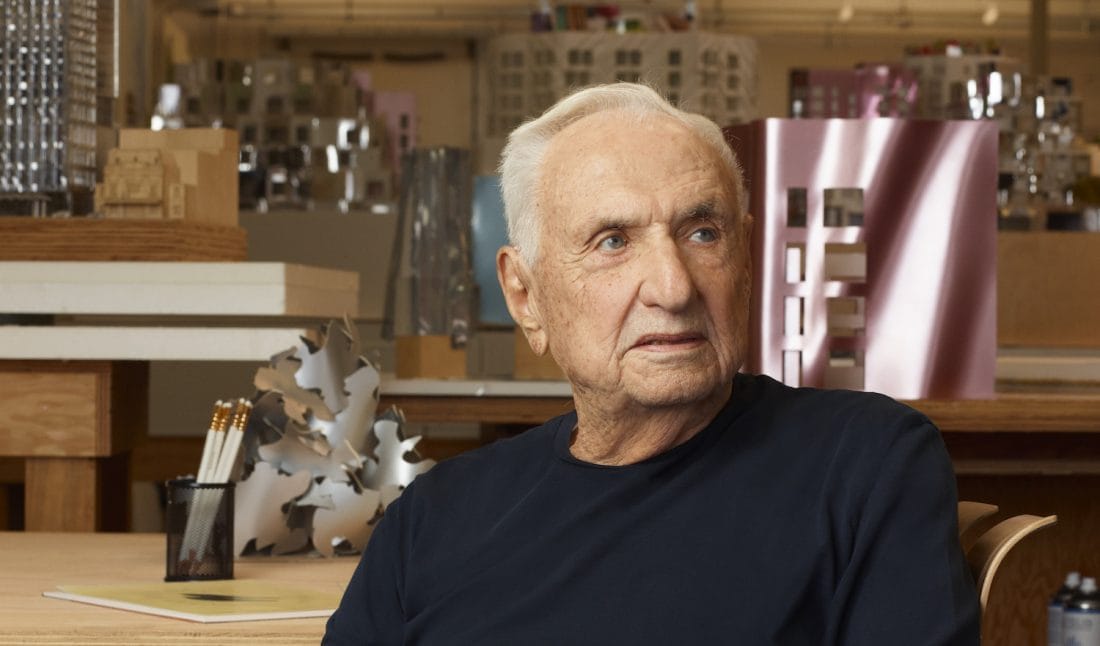




At the age of 96, the icon of contemporary design passed away from respiratory illness on December 5, 2025, in California. From the Guggenheim Museum in Bilbao to the Louis Vuitton Foundation, the Picasso of architecture and winner of the Pritzker Prize (1989) revolutionized this urban art form with his bold, sculptural, and deconstructed buildings. Here are five dates that mark his impressive career.
“His work, sometimes controversial but always captivating, has been described as iconoclastic, turbulent, and ephemeral, but in awarding him this prize, the jury salutes that restless spirit that has made his buildings a unique expression of contemporary life…” This is how an independent jury presented him with the Pritzker Prize in 1989 in Nara, Japan. Created in 1979, this “Nobel Prize of architecture” honors each year living architects whose achievements demonstrate their talent, vision, and commitment.
Born in 1929 in Toronto, Canada, to a Jewish family of Polish origin, the young Frank Owen Goldberg, as he was formerly known, spent a lot of time in his grandfather’s hardware store, where he handled and experimented with all kinds of materials. After moving to California, the budding artist studied architecture at the University of Southern California, before attending the Harvard Graduate School of Design. From his first residences and projects in the 1960s, his style was already breaking with the architectural traditions of the time. He asserted his preference for form and movement over symmetry or pure functionalism, and turned to inexpensive and ordinary materials.
1978
Voir cette publication sur Instagram
While Frank Gehry’s work focused on private homes and low-profile projects, 1978 marked an international turning point in the artist’s career. The architect, then 49 years old, renovated his own home in Santa Monica, California, using unconventional materials such as corrugated metal, reclaimed wood, and wire mesh. Going against the grain of classical symmetry, his work is deconstructed and stands as a manifesto of his style. A veritable inhabited sculpture that could have come straight out of a movie, it did not fail to attract the attention of the artistic world, which praised his unique vision of space and movement.
1993
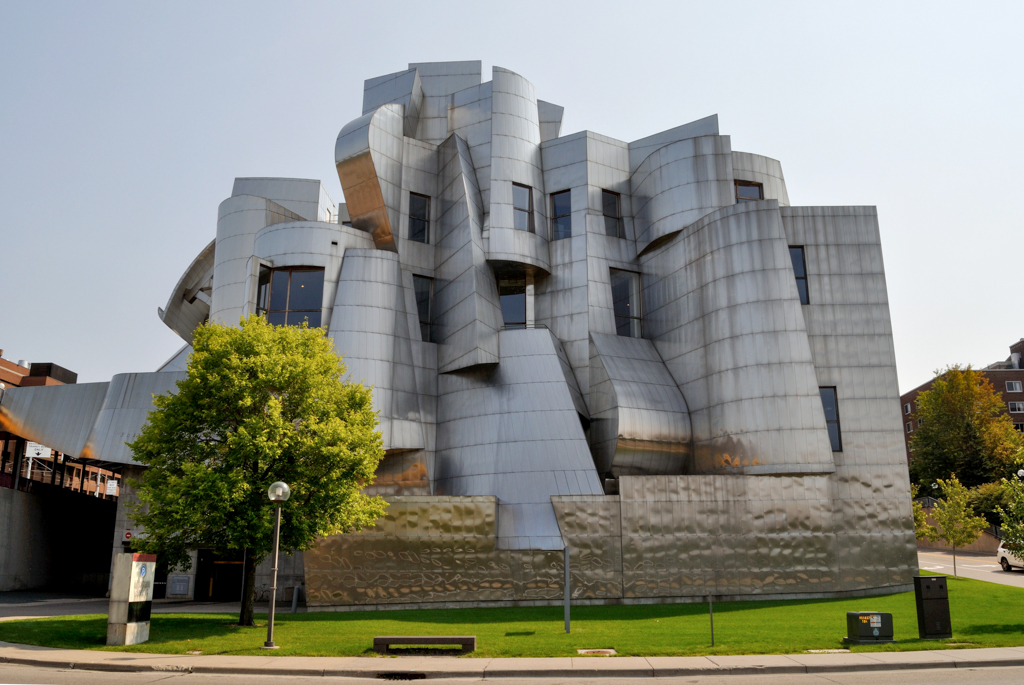
Bolstered by his newfound fame, Frank Gehry, 64, went on to complete a series of high-end residential projects and small public commissions in the 1980s. More precise and refined in his style, he was entrusted with the design of the Weisman Art Museum in Minneapolis, USA, his largest project at the time. In 1993, the building was unveiled to the general public and stood out for its asymmetrical facades, fragmented volumes, and sculptural lines, playing on steel, brick, and glass. At that point, he confirmed his ability to transform institutional architecture into a major work of art.
1997
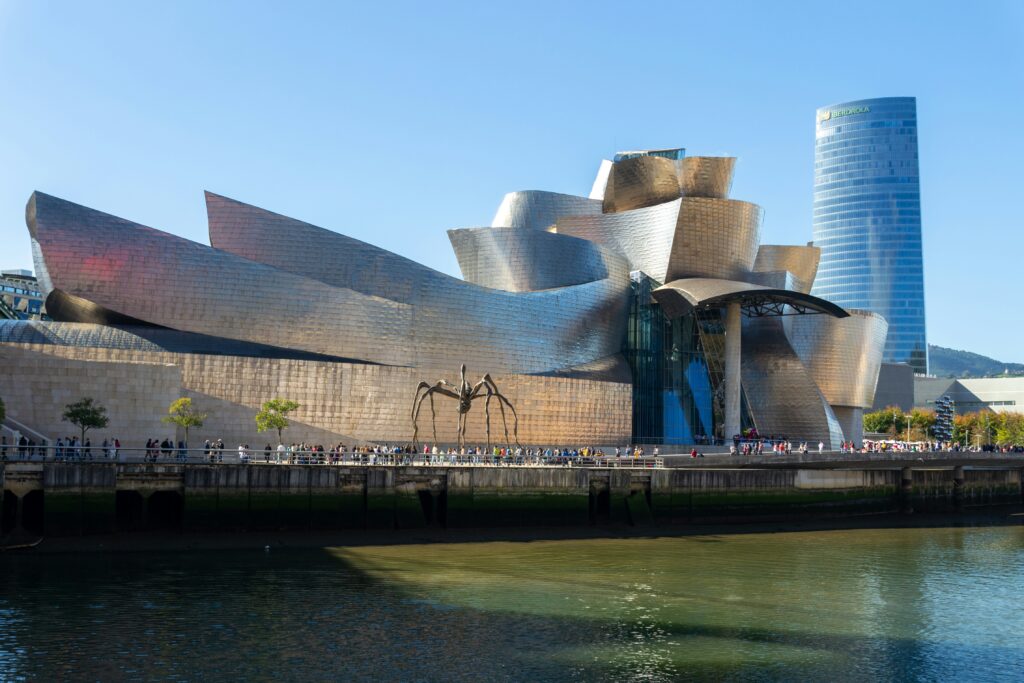
Four years later, the architect made a big splash with the Guggenheim Museum in Bilbao, Spain. The architect was then 68 years old. Titanium, glass, and limestone enhance the undulating curves and flowing volumes. The museum’s opening was a huge success, even creating the “Bilbao effect.” Journalist and architecture critic Herbert Muschamp even referred to what he considered a “miracle in Bilbao” in the New York Times: “If you want to dive into the heart of American art today, you’ll need a passport… you’ll have to pack your bags, leave the United States and go to Bilbao.” Even today, the building remains a flagship work of Gehry’s oeuvre.
2003
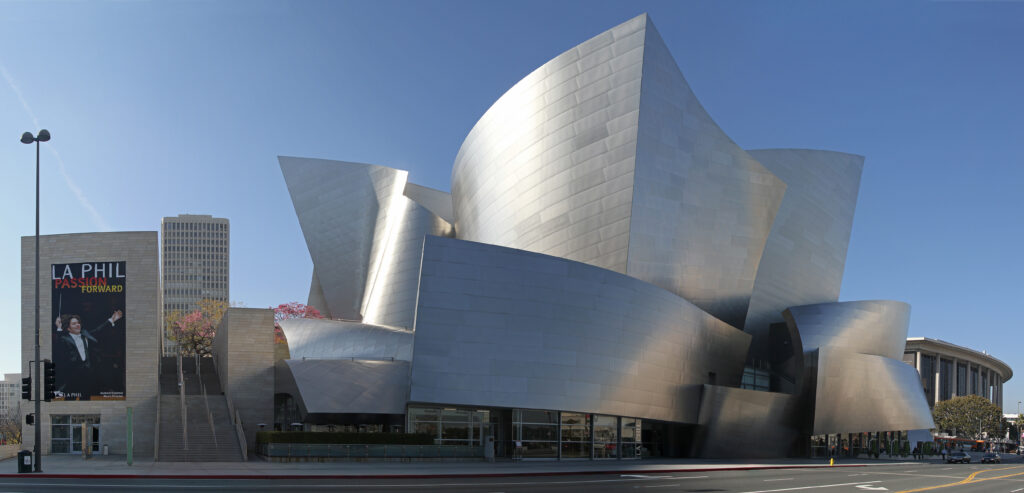
This date marked the conclusion of many years of collaboration between Frank Gehry and the Walt Disney Company. In 1987, Lillian Disney, the founder’s widow, donated $50 million for the commission of the Walt Disney Concert Hall in Los Angeles, USA. After the delivery of the first sketches in 1991, the project was put on hold and construction actually began eight years later, before the inauguration in 2003. The architect was then 74 years old. The auditorium consists of a stainless steel shell, wood, and undulating facades reminiscent of sails or petals in a fluid and resolutely modern style. Despite some criticism, the architect succeeded in proving that aesthetics can coexist with the acoustic and functional requirements of such a venue.
2014
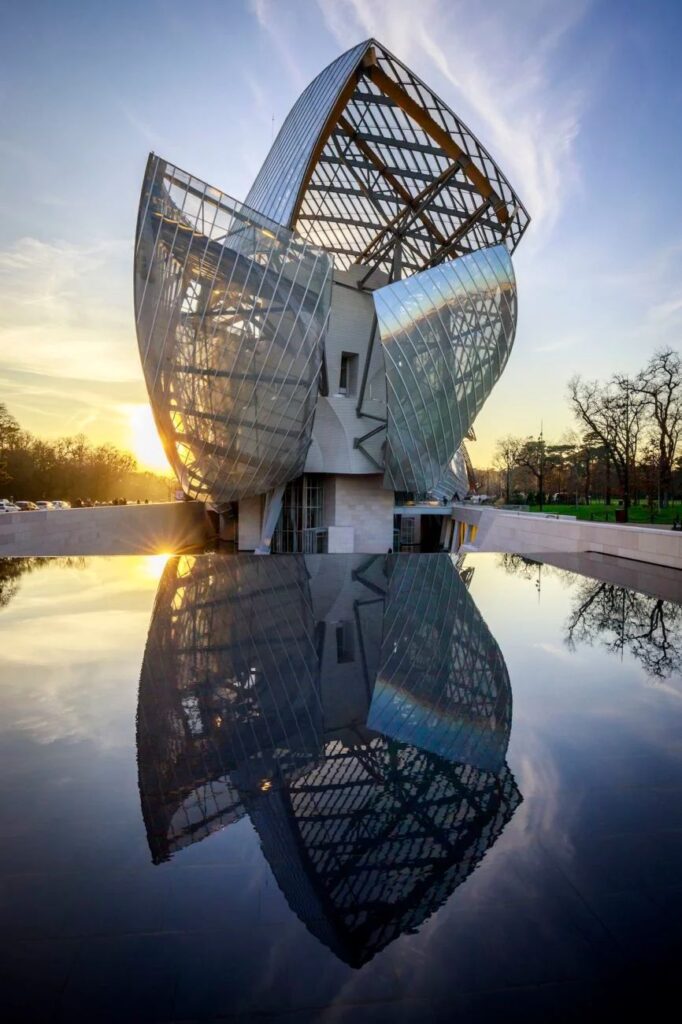
Almost 10 years later, Frank Gehry unveiled a new large-scale project, this time in Paris. At the request of the LVMH group, the architect set up the Louis Vuitton Foundation, a contemporary art museum located at the entrance to the Bois de Boulogne in Paris. The building features 3,600 panels on 12 glass sails and 19,000 panels of ductal (fiber-reinforced concrete), like a metaphor for a ship or a sailboat. Inside, its large white spaces house 11 exhibition galleries. “Like the ever-changing world, we wanted to design a building that evolves with the time of day and the light to create a sense of transience and continual change,” Frank Gehry explained about his work.
“Deeply saddened” by the loss of “a very dear friend” for whom he will “forever hold boundless admiration,” LVMH Group CEO Bernard Arnault paid tribute to him in person. The businessman praised “one of the longest, most intense, and most ambitious creative partnerships I have ever had the privilege of experiencing.”
Frank Gehry passed away on December 5, 2025, at his home in California. Considered the greatest architect of his time, the artist created a multitude of works that left their mark on both his peers and new designers. The Lou Ruvo Center for Brain Health in Las Vegas, the Dancing House in Prague, the Experience Music Project in Seattle… Frank Gehry leaves behind major works, made up of dreamlike lines and sculptural curves, which will continue to influence several generations. The opening of his final major work, the 42,000 m² Guggenheim Abu Dhabi on Saadiyat Island in the United Arab Emirates, projected for 2025 has been delayed. Construction began in 2011 and is now nearing completion, although no specific date has been announced at this time.
Read also : Gerhard Richter, a major German painter of the postwar period
Featured photo : Unsplash