






Exhibited at the Fondation Louis Vuitton, Alexander Calder left a lasting mark on the art world through his vision of movement and his works, which still remain today a source of inspiration and reflection for his admirers.
Alexander Calder is now considered one of the major artists of the 20th century. Known for his famous suspended mobiles, he profoundly renewed sculpture by introducing movement, chance, and space into it.
From engineering to art
Alexander Calder was born in 1898 in the United States into a family of artists. His father was a sculptor and his mother a painter. This creative environment played a fundamental role in his development, even though he did not initially set out to pursue an artistic career. Calder first studied engineering, which gave him a technical understanding of materials and mechanisms, as well as a way of thinking about balance, movement, and structures. It was only around the age of 25 that he turned back to art, reconnecting with his family heritage. He then trained at the Art Students League of New York, where he learned drawing and painting.
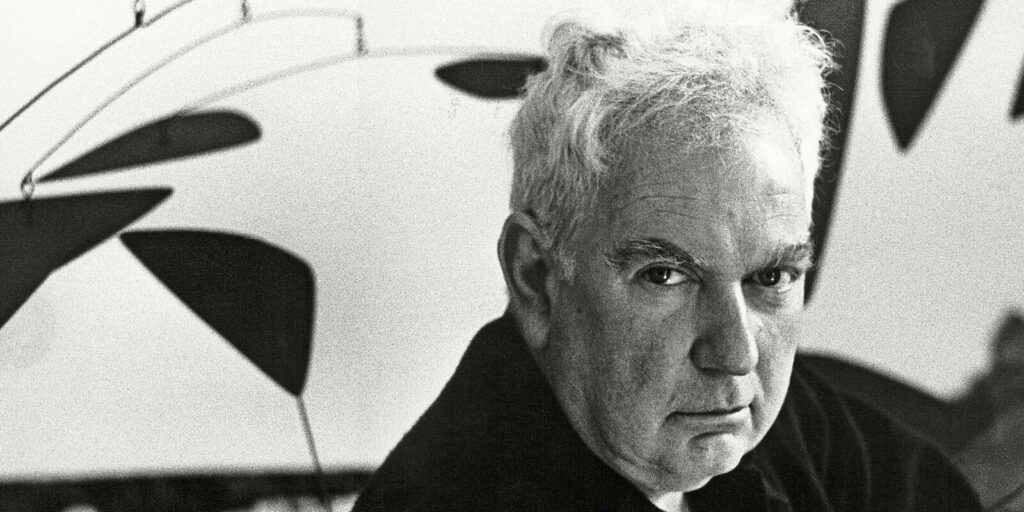
In 1926, a major turning point occurred: Calder moved to Paris, at the heart of the artistic avant-garde. There, he associated with figures such as Fernand Léger, Piet Mondrian, and Marcel Duchamp. His early work was marked by drawing and caricature, which he sold to the press, but also by a particular focus on movement. Very quickly, he created the Cirque Calder (1926–1931), a unique work composed of small animated figurines that he manipulated himself during performances. This creation already announced his obsession with movement and staging.
At the same time, he developed his famous wire sculptures, which he called “drawings in space.” These works depict human or animal figures with great economy of means, capturing the essence of movement with just a few lines.
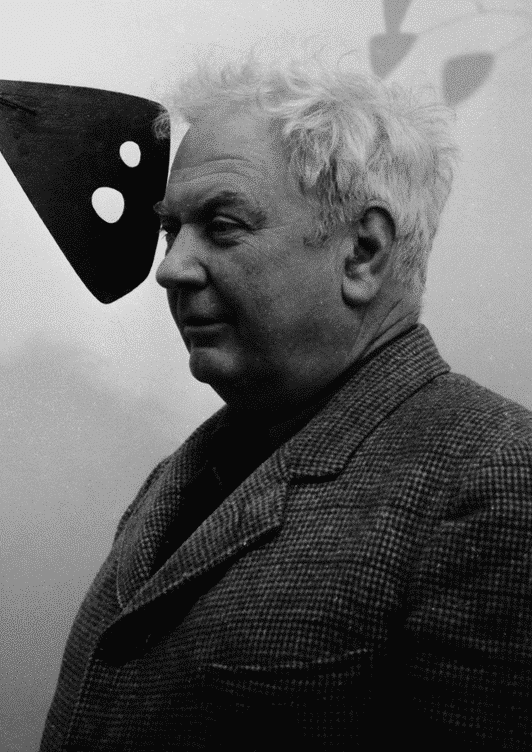
A decisive encounter with Piet Mondrian marked another turning point. Fascinated by his abstract compositions, Calder imagined giving them movement. Thus, in the early 1930s, he invented the first mobiles—abstract sculptures set in motion by air or mechanical systems.
Painting, drawing, sculpture…
Calder’s work is marked by several emblematic creations that illustrate his inventive genius. Among the notable works is Small Sphere and Heavy Sphere (1932–1933), an installation in which elements collide randomly, producing unpredictable sounds and movements.
Voir cette publication sur Instagram
Calder also developed stabiles, fixed yet monumental sculptures often installed in public spaces. These painted steel works play with gravity and balance while conveying a sense of lightness.
In the 1940s, he created the Constellations series, made of wood due to metal shortages during the war. These works explore abstract forms connected in space, evoking cosmic systems.
Voir cette publication sur Instagram
Finally, works such as the Mercury Fountain (1937), created for the Paris World’s Fair, reflect his political engagement and his ability to incorporate unexpected materials.
Throughout his career, Calder never stopped experimenting: painting, drawing, sculpture, jewelry… His work is characterized by great formal freedom and a constant search for balance between lightness and structure.
Calder at the Fondation Louis Vuitton
Today, Calder’s work is celebrated in Paris through the exhibition “Calder. Dreaming in Balance”, presented at the Fondation Louis Vuitton from April 15 to August 16, 2026. This major retrospective marks a double anniversary: 100 years since his arrival in Paris and 50 years since his death. It brings together nearly 300 works, covering half a century of creation. The exhibition is organized chronologically, allowing visitors to follow the artist’s evolution, from his early figurative works to his monumental sculptures.
Among the major pieces on display are the Cirque Calder, exceptionally loaned for the occasion, as well as wire portraits, iconic mobiles, and monumental stabiles. The exhibition takes over the entire building designed by Frank Gehry, as well as the outdoor spaces, where some monumental sculptures are installed. It particularly highlights the relationship between Calder’s works and the architecture, creating a true choreography in space.
Voir cette publication sur Instagram
Beyond a simple retrospective, the exhibition emphasizes the fundamental themes of his work: movement, light, gravity, sound, and space. It also places Calder within his artistic context by presenting works by contemporary artists such as Mondrian, Picasso, and Miró, demonstrating the extent of his influence and his dialogue with the avant-garde.
According to critics, this exhibition is both immersive and festive, offering a comprehensive view of an artist who quite literally “set the world in motion.” Alexander Calder thus appears as a deeply innovative artist, at the crossroads of art and science.
Read also : Ludwig Mies van der Rohe: 140 years of geometric purity
Featured photo : Calder Foundation