

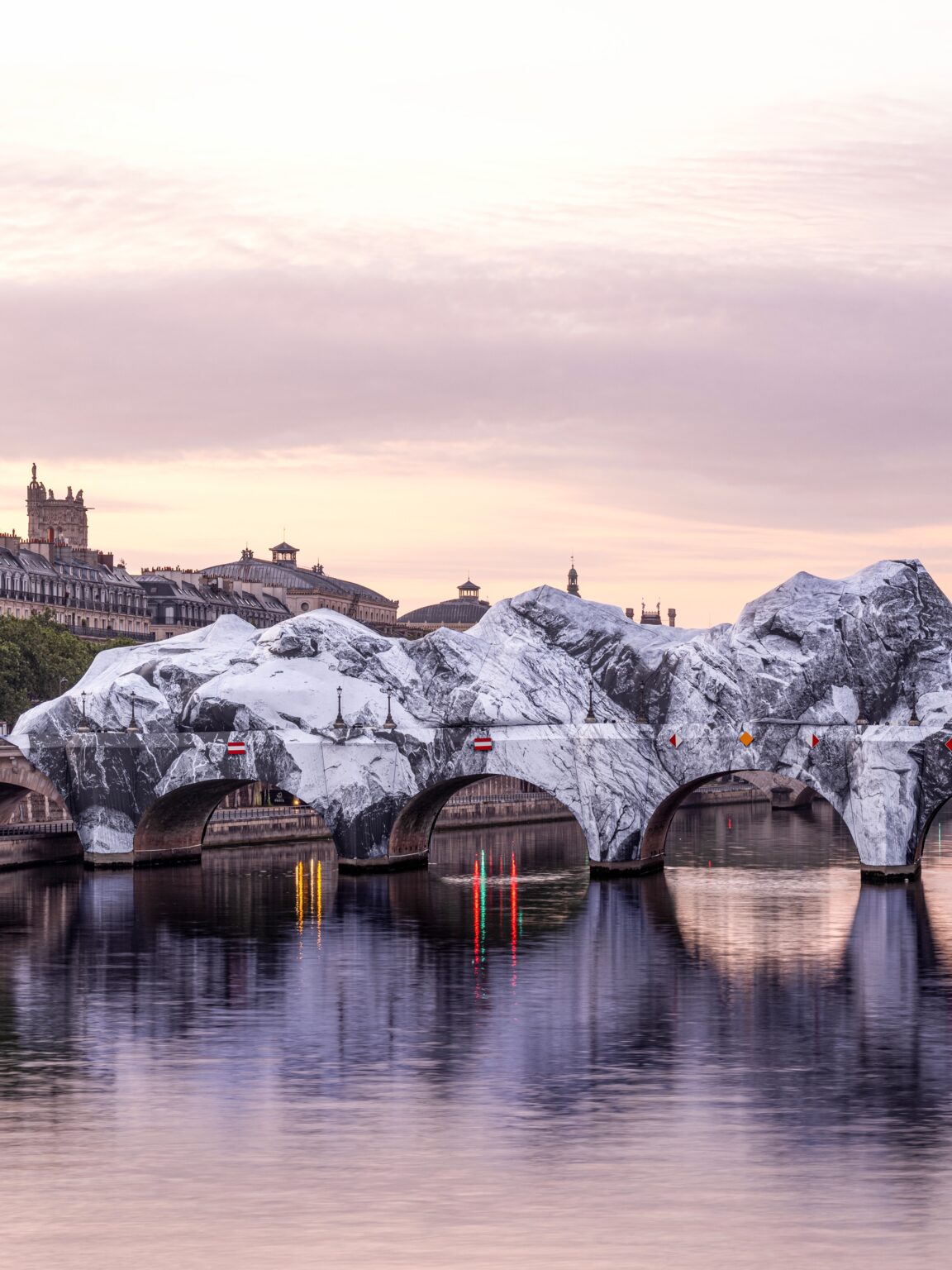




With La Caverne du Pont Neuf, French artist JR transforms Paris’s oldest bridge into a monumental, immersive installation. Part homage to Christo, part technical feat, and part collective dream, this spectacular work revives the memory of a capital that has never ceased to make public space a playground for artistic experimentation.
Originally scheduled for June 6–28, the opening of JR’s installation was postponed after the structure was damaged by inclement weather. A new date will be set once the ongoing assessment is complete.
La Caverne du Pont Neuf, a mineral dream in the heart of Paris
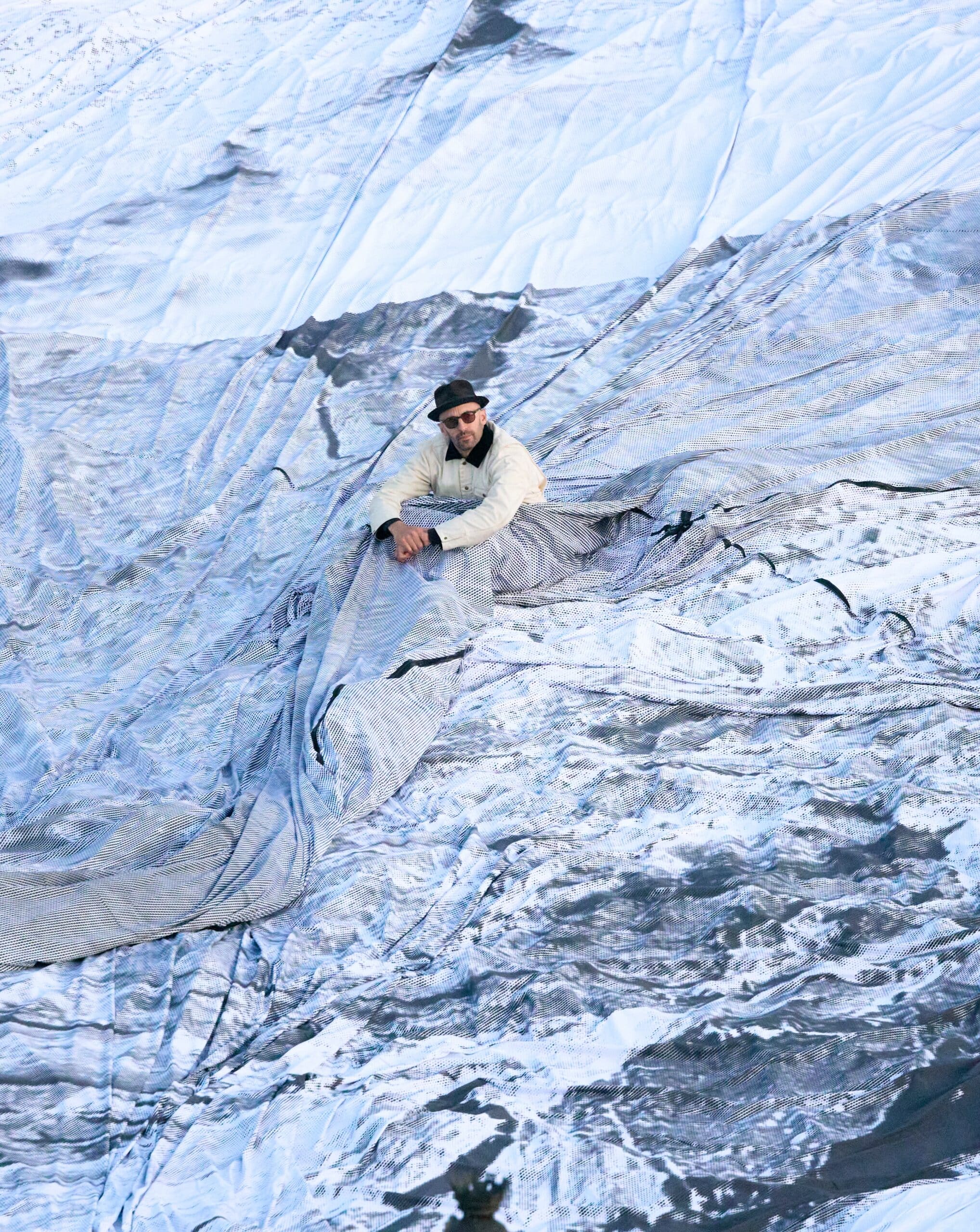
In Paris, certain monuments seem immutable. Yet, every forty years, the Pont Neuf is reborn in a new form.
After being wrapped in 1985 by Christo and Jeanne-Claude in a massive stone-colored canvas, the capital’s oldest bridge is now undergoing a transformation under the direction of JR. With La Caverne du Pont Neuf, the artist envisions a gigantic cave emerging from the middle of the Seine, as if the city’s innermost depths were suddenly rising to the surface.
The installation covers the bridge with a spectacular inflatable structure nearly 120 meters long. Composed of dozens of printed canvases mimicking the appearance of rock, it transforms crossing the monument into a unique sensory experience.
For JR, the cave is a universal symbol. It evokes the origins of humanity, refuge, mystery, and the collective imagination. The artist aims to turn the Pont Neuf into a space for contemplation where architecture, memory, and illusion interact with the Parisian landscape. This immersive experience is enhanced by a sound installation created by Thomas Bangalter, former member of Daft Punk.
More than a monumental installation, La Caverne du Pont Neuf is an invitation to rediscover a familiar monument from a completely new perspective. For a few weeks, Paris ceases to be a backdrop and becomes an experience. With La Caverne du Pont Neuf, he has likely created one of the most ambitious projects of his career. More than 800 people participated in its creation, in an extraordinary project designed without drilling into or altering the historic monument. Every element was conceived to fully respect the architecture of the Pont Neuf.
JR, the artist who transforms the world’s walls into an open-air gallery
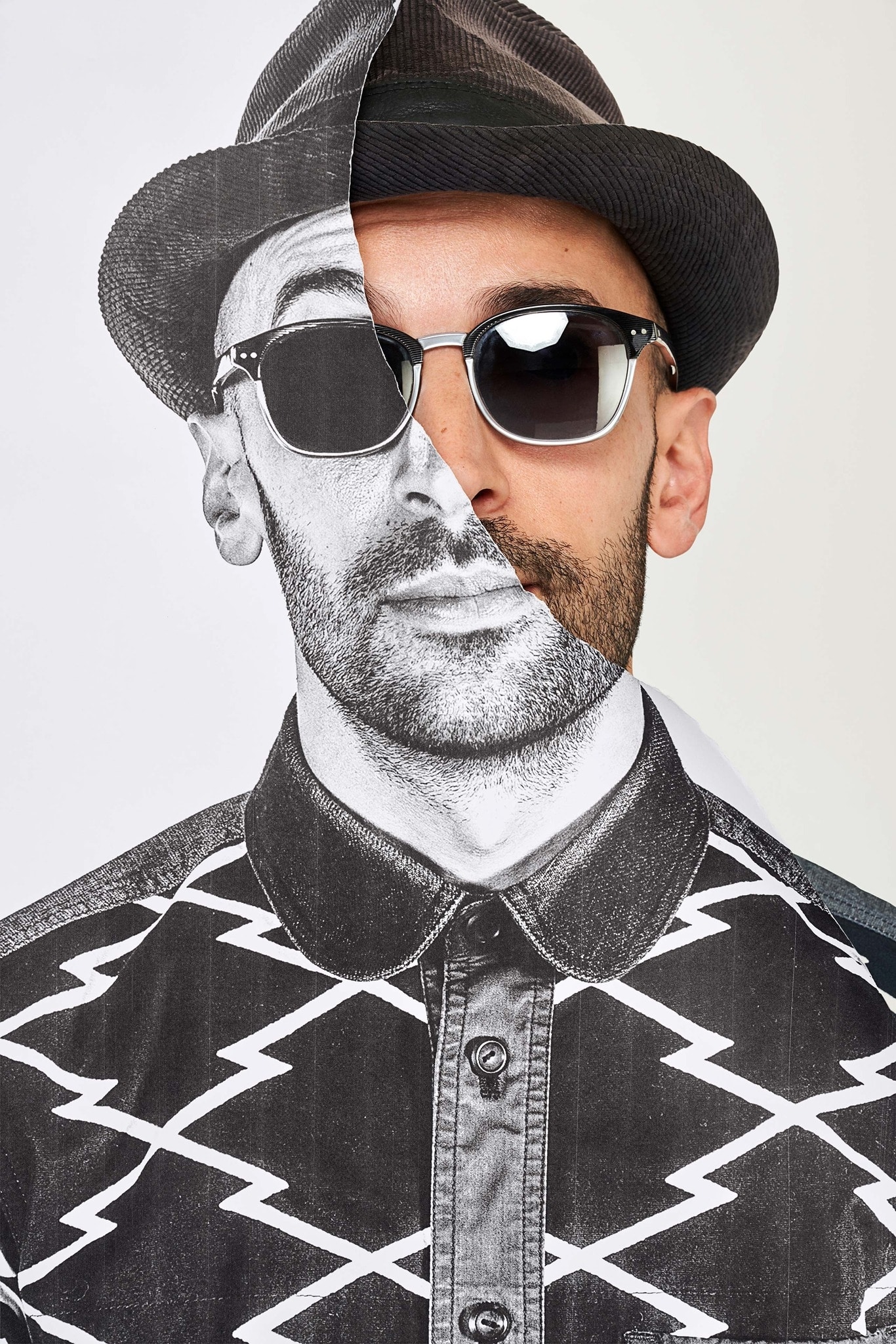
Behind this extraordinary project lies one of the most influential French artists of his generation.
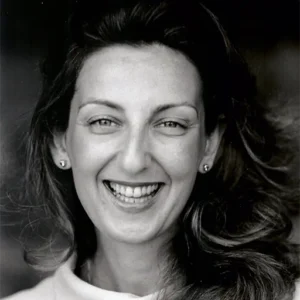
Born in Paris on February 22, 1983, and raised between Montfermeil and Belleville, JR discovered graffiti at a very young age. As a teenager, a camera he found in the Paris metro changed his destiny. From then on, his gaze shifted away from walls to focus on the people who inhabit them.
Photographer, filmmaker, andcontemporary artist, he gradually developed an instantly recognizable visual language: massive black-and-white portraits pasted onto facades, monuments, or forgotten spaces. His ambition is simple yet radical: to make art accessible to all and to give visibility to those we rarely look at.
His first major project, Portrait of a Generation (2004–2006), displayed the faces of young people from Les Bosquets de Montfermeil on the walls of Paris. By overturning the clichés associated with French suburbs, he laid the foundations for a profoundly humanistic body of work that has never ceased to place humanity at the heart of the landscape.
Today, his work is exhibited in the world’s greatest museums, yet he continues to favor public spaces. For him, walls remain the greatest art gallery there is.
Paris, his life-size creative laboratory
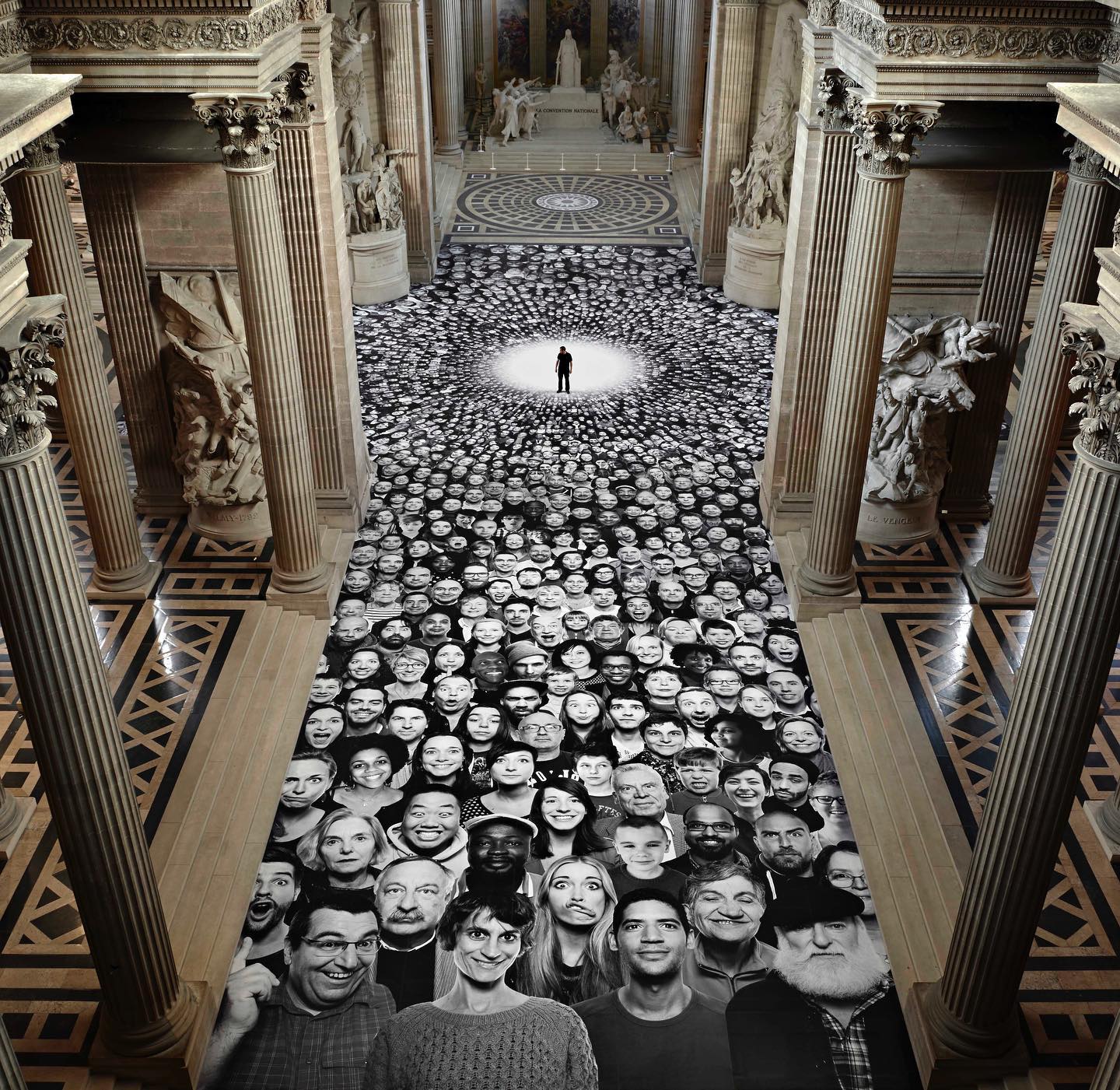
While JR’s work now shines across every continent, Paris remains his preferred canvas.
In 2014, he transformed the Panthéon into a gigantic human mosaic by covering its restoration tarpaulin and nave with over 4,000 portraits of anonymous people as part of the project Au Panthéon!. A way of symbolically bringing citizens into one of the temples of the Republic.
Two years later, he created one of his most famous installations at the Louvre. Thanks to a monumental anamorphosis, the glass pyramid designed by I. M. Pei appears to disappear entirely into the palace’s historic façade. The installation went viral around the world.
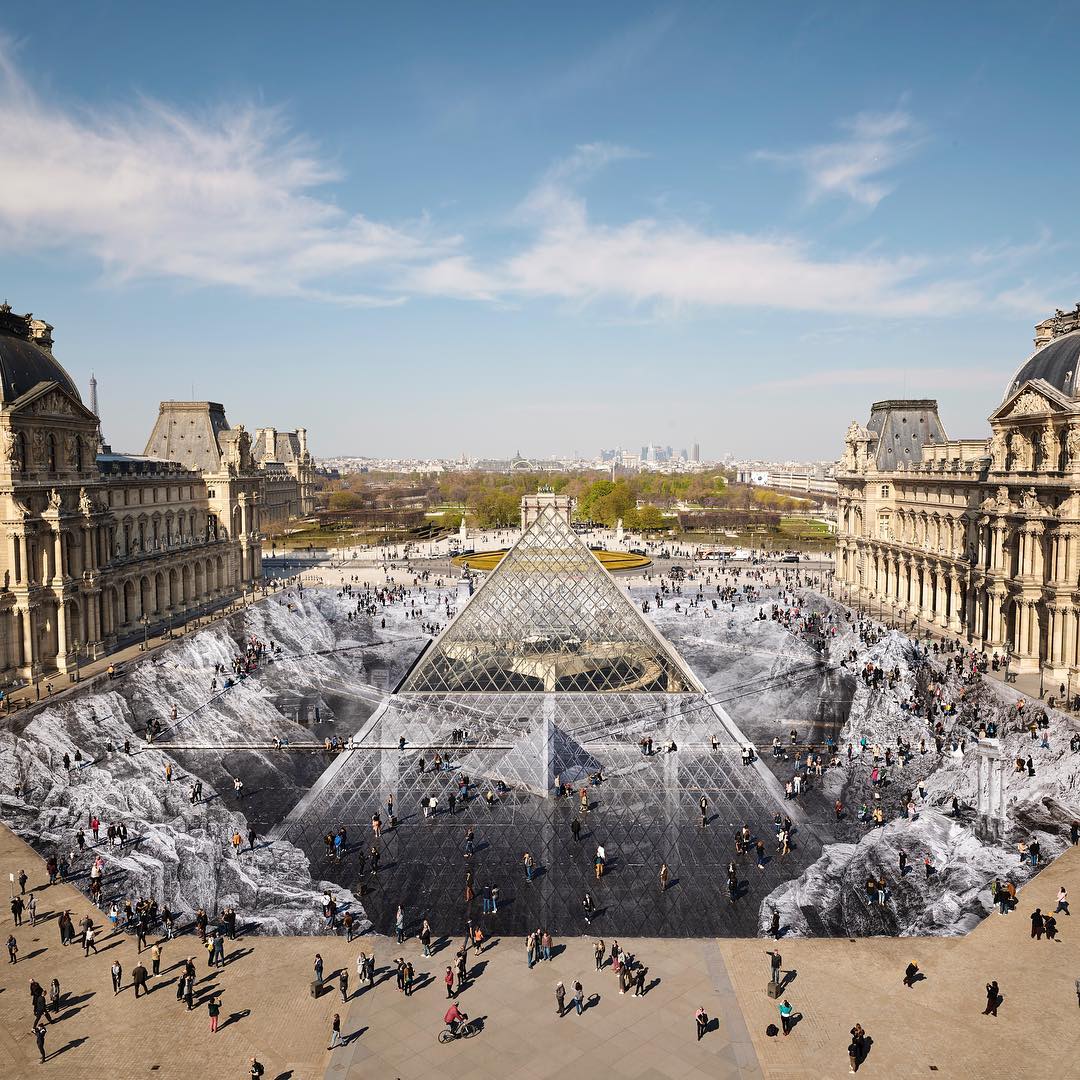
In 2019, he repeated the experiment, this time creating the illusion that the pyramid is rising from the depths of the ground, like an archaeological relic unearthed after centuries of being buried.
His collaboration with Parisian institutions also continued at the National Assembly. In December 2015, on the occasion of COP21, he created The Standing March, a projection produced with filmmaker Darren Aronofsky. While demonstrations were banned following the November 13 attacks, thousands of faces appeared on the façade of the Palais Bourbon in a virtual, silent citizens’ march.
More recently, in 2023, JR transformed the facade of the Opéra Garnier into a massive rock cave that seemed to engulf the monument. A spectacular intervention that now appears as the natural prelude to La Caverne du Pont Neuf.
From Rio to Times Square : a monumental work across the globe
For over twenty years, JR has been building a global body of work where art engages with social, political, and human issues.
In 2007, he made a lasting impression with Face 2 Face. Gigantic portraits of Israelis and Palestinians working in the same professions were displayed on either side of the separation wall. More than just a work of art, this installation became a humanistic gesture highlighting what brings people together across borders.
The following year, he took over the Morro da Providência favela in Rio de Janeiro with Women Are Heroes. Huge female faces covered the facades, rooftops, and stairways of the neighborhood. The artist aims to pay tribute to these women who support their communities while often remaining invisible.
The project then traveled to Kenya, Liberia, Sierra Leone, Cambodia, and India. In Jaipur, in 2009, the monumental portraits interact with the palaces and alleyways of the Pink City, creating a striking contrast between historical heritage and contemporary art.
In 2011, JR launched Inside Out, a global participatory project allowing anyone to print their portrait in large format to display it in public spaces. Two years later, Times Square in New York was covered with thousands of anonymous faces from around the world. The work became a visual manifesto celebrating human diversity.
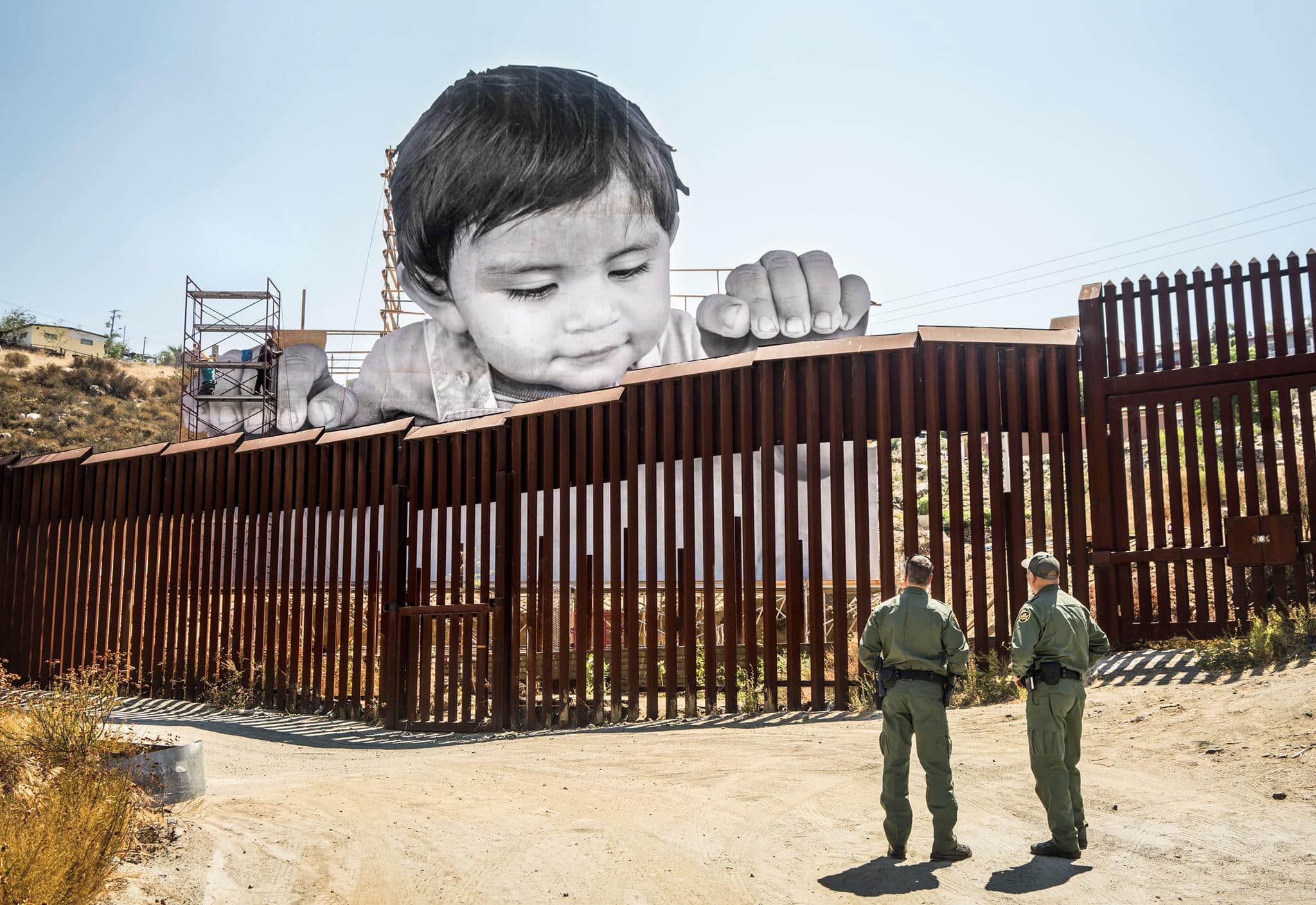
In 2017, he created Kikito on the border between Mexico and the United States. The giant photograph of a young Mexican boy seems to gaze curiously at the border wall. The image immediately went viral and became a symbol of contemporary migration issues.
The following year, in Berlin, his project Giants accompanied the European Athletics Championships. Huge athletes appear to be leaping over the city’s buildings, notably near the Brandenburg Gate, transforming the urban space into a stage for monumental performance.
In Florence, in 2021, La Ferita creates the illusion of a gigantic crack opening in the façade of the Palazzo Strozzi. Created after the lockdowns, the work symbolizes the fragility of the cultural world while revealing what lies behind the walls of art institutions.
More recently, with Déplacé·e·s, launched in 2022, JR sheds light on the fate of populations forced into exile. Huge portraits of refugee children are displayed collectively in Ukraine, Colombia, Mauritania, and Rwanda. A way of reminding us that behind every humanitarian crisis lie, above all, faces and stories.
In the footsteps of Christo: when monuments become works of art
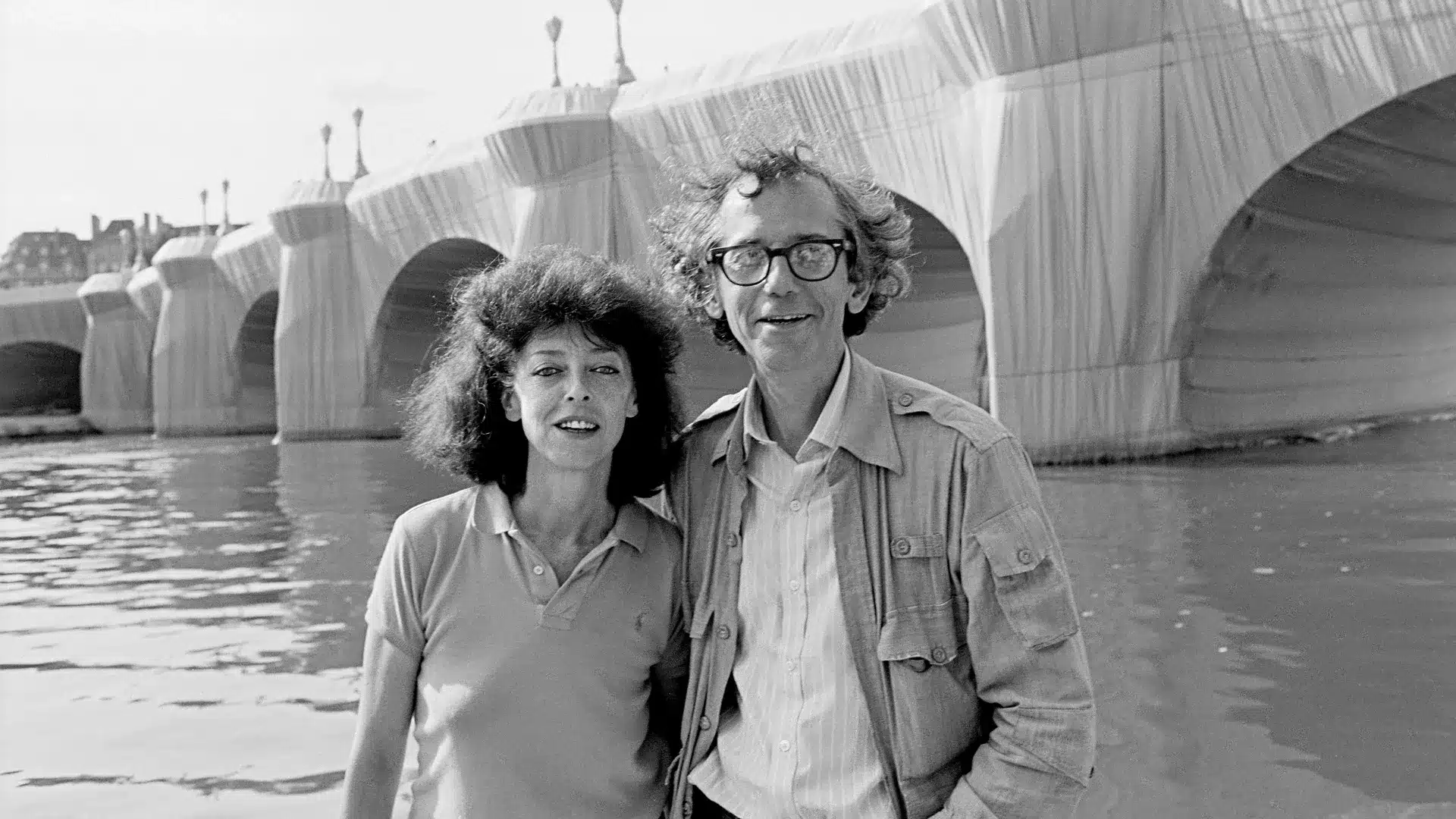
It is impossible to mention La Caverne du Pont Neuf without returning to one of the most significant artistic events of the 20th century: The Wrapped Pont Neuf by Christo and Jeanne-Claude.
In September 1985, after nearly ten years of administrative and political negotiations, the famous duo covered the bridge with 41,800 m² of sandstone-colored fabric held in place by more than 13 kilometers of rope. For fourteen days, Paris watched as its iconic monument was transformed into a monumental sculpture floating above the Seine.
At the time, the project sparked as much enthusiasm as it did criticism. Some denounced it as an affront to heritage, while others celebrated it as a revolutionary work. Ultimately, more than three million visitors came to admire the installation, now considered one of the masterpieces of contemporary ephemeral art.
What was fascinating about Christo and Jeanne-Claude was their ability to reveal a monument by concealing it. By wrapping it, they forced the viewer to rediscover its volumes and its presence in the urban landscape.
Forty years later, JR does not replicate this gesture. He extends it. Where Christo hid the bridge, JR transforms it into an imaginary landscape. The work is no longer merely an object to be contemplated, but a universe to be traversed.
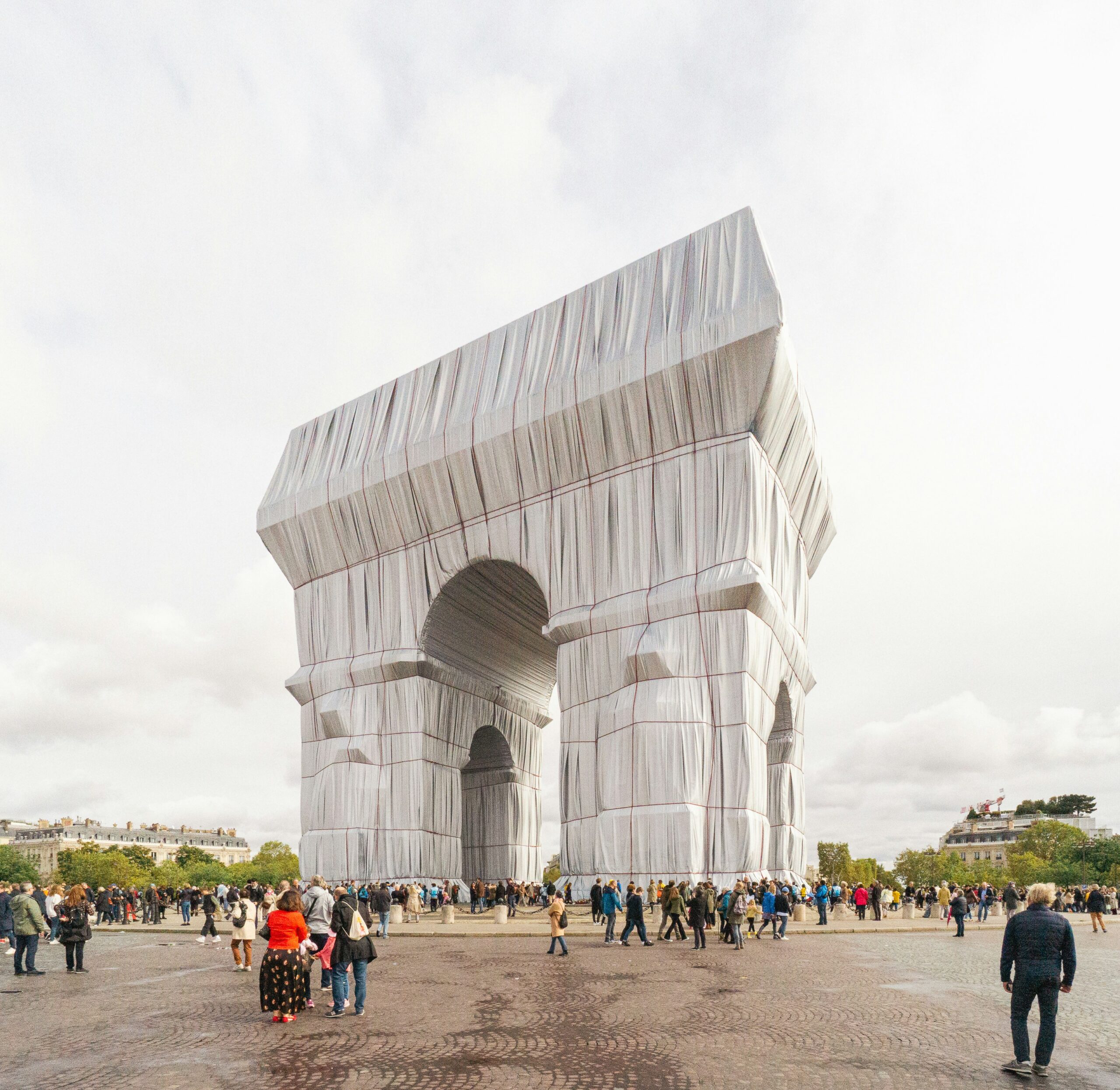
This tradition of monumental art has, in fact, endured. In 2021, the Arc de Triomphe is in turn transformed thanks to a project conceived by Christo and Jeanne-Claude as early as the 1960s. Realized posthumously, the work covers the monument with 25,000 m² of recyclable bluish-silver fabric held in place by 3,000 meters of red ropes. For sixteen days, more than six million visitors came to admire this spectacular vision.
In New York, The Gates in Central Park, in London The Weather Project by Olafur Eliasson, and the immense hands of Lorenzo Quinn emerging from the Grand Canal in Venice all reflect this same ambition: to take art out of museums and bring it into everyday life.
With La Caverne du Pont Neuf, JR follows in this tradition while asserting a profoundly contemporary vision. In an era dominated by screens and virtual images, he still chooses the power of reality, monumental scale, and collective emotion.
For a few weeks, Paris will no longer be just a city-museum. It will once again become what it has always been in the eyes of artists: a laboratory of ideas, an open-air theater, and an inexhaustible source of imagination.
Read also > 7 exhibitions to discover in the spring in Paris and beyond
Featured photo : © JR Artist