





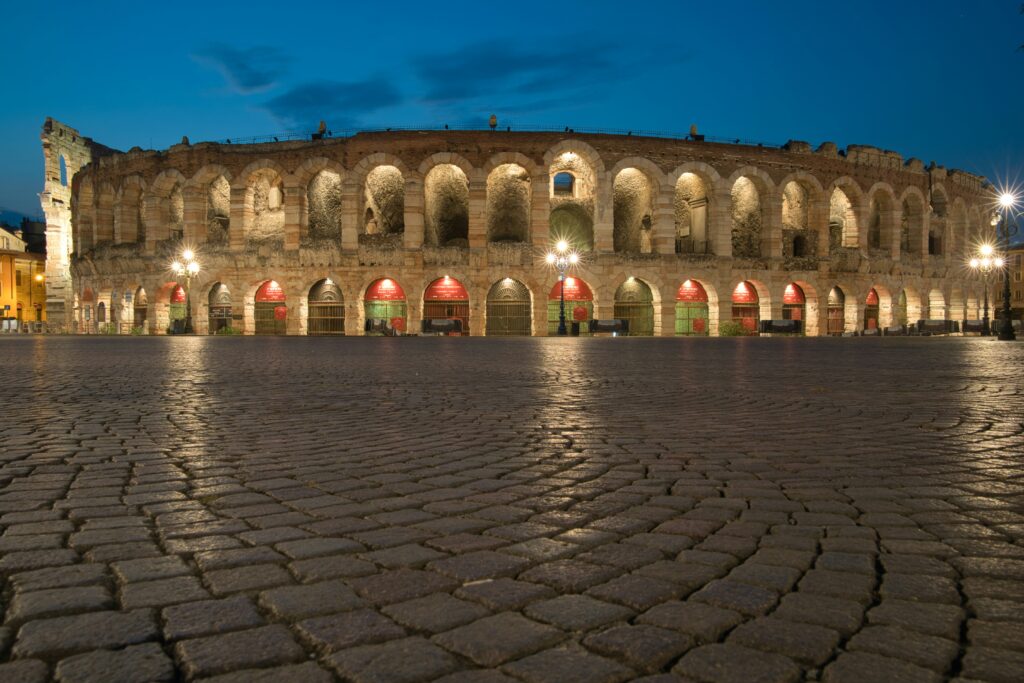
Milano Cortina 2026 will be remembered as the first Winter Olympics to feature venues spread across three different regions. This uniqueness continued with the closing ceremony, which also broke new ground by taking place in a historic venue, namely the Verona Arena. The city of Romeo and Juliet thus became the city of love… and opera.
From Milan to Verona, it’s just a stone’s throw… or rather a region.
While the former is the capital of Lombardy, the latter, associated worldwide with Romeo and Juliet, is the capital of Veneto. It is also a magnet for fans of popular opera, with the Arena Di Verona festival held there every year since 1913, from mid-June to early September.
Despite the distance (105 miles) between them, the two cities saw their hearts beat as one on Sunday, February 22, 2026, that of opera lovers and Shakespeare’s star-crossed lovers.
During the closing ceremony of the Milano Cortina Winter Olympics, the love of both was combined with a spectacle worthy of La Scala, featuring its mythical characters, all introduced by Rigoletto, the tragic jester from Giuseppe Verdi’s eponymous opera.
An ancient site dating back to the 1st century
Long before the tragic passion of its 16th-century lovers, Verona was a Roman province, renowned in particular for its ancient amphitheater. Built in 30 AD, it could accommodate nearly 30,000 spectators.
This Roman arena, one of the best preserved in Italy, welcomes up to 20,000 spectators on the evenings of the Arena Di Verona festival, a mecca for transalpine opera.
The Verona Arena gained its operatic reputation in 1822 with the performance of Rossini’s lyrical prelude before its first opera season in 1856. But it was not until August 10, 1913, on the occasion of the centenary of Giuseppe Verdi’s birth, that the festival really took off. In 1947, Maria Callas even performed Amilcare Ponchielli’s La Gioconda.
An art form recognized by UNESCO
The opening ceremony of the Winter Olympics had already offered a glimpse of that proudly Italian cultural phenomenon that is opera, with its three creative geniuses: Verdi, Rossini, and Puccini. Elevated to the status of pop mascots, they performed a choreographed routine to the Italian pop sounds of the Milano-Cortina anthem, itself based on Righeira’s Vamos a la Playa.
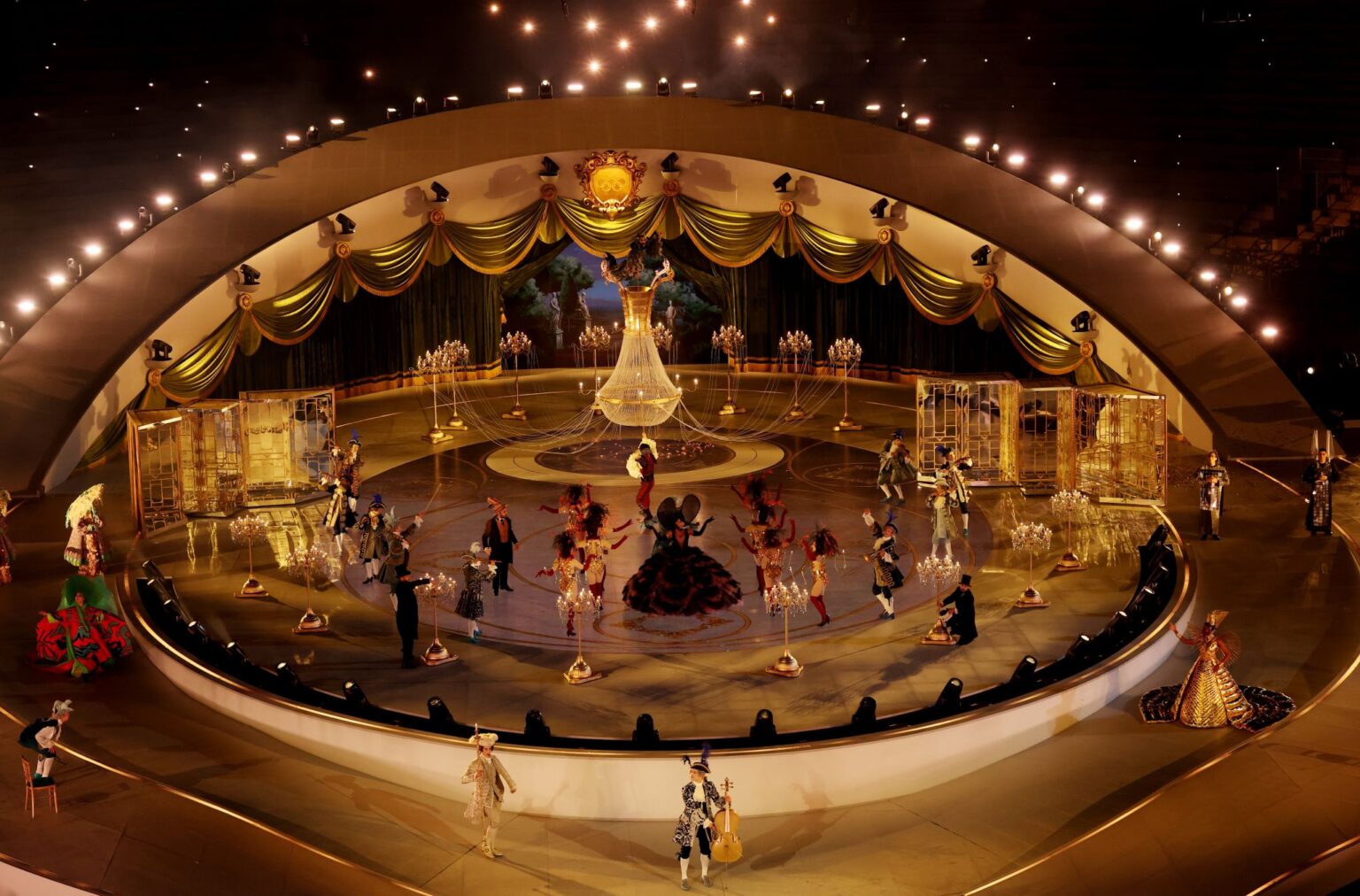
Entitled “Beauty in Action” or “A Night at the Opera”, the closing ceremony paid tribute to this lyrical art form, which has been listed as part of UNESCO’s Intangible Cultural Heritage of Humanity since 2024.
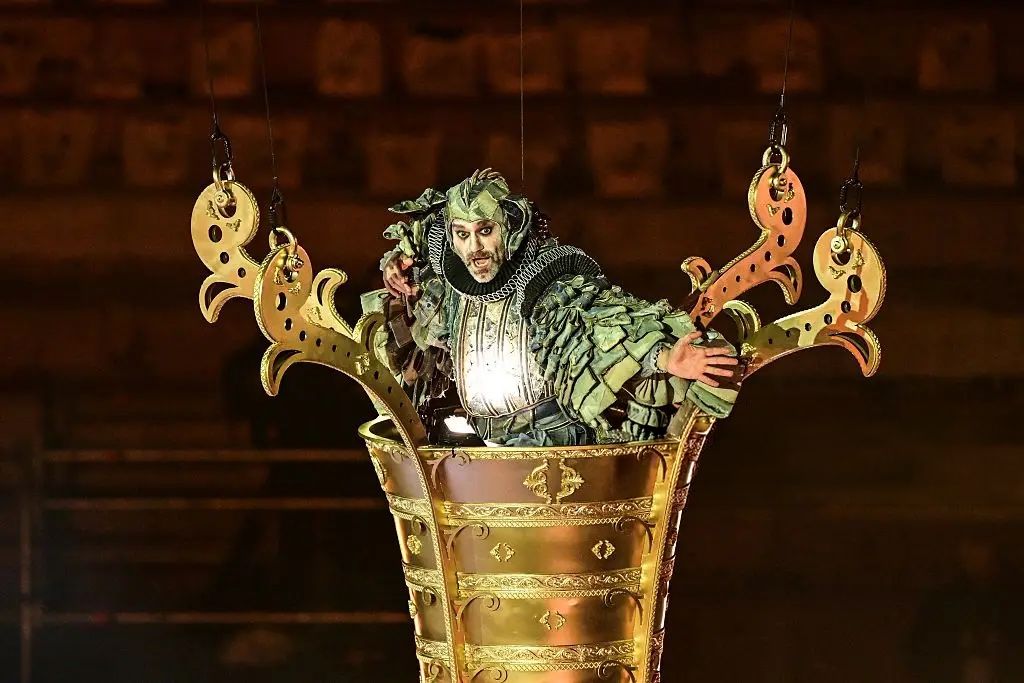
In front of millions of television viewers watching this colorful and medal-filled show, the most iconic characters from the classical repertoire came back to life. Emerging from his box and catapulted into the role of master of ceremonies, Rigoletto, the tragic jester created by Giuseppe Verdi, made his way under the arches of the arena, revealing the backstage of the opera.
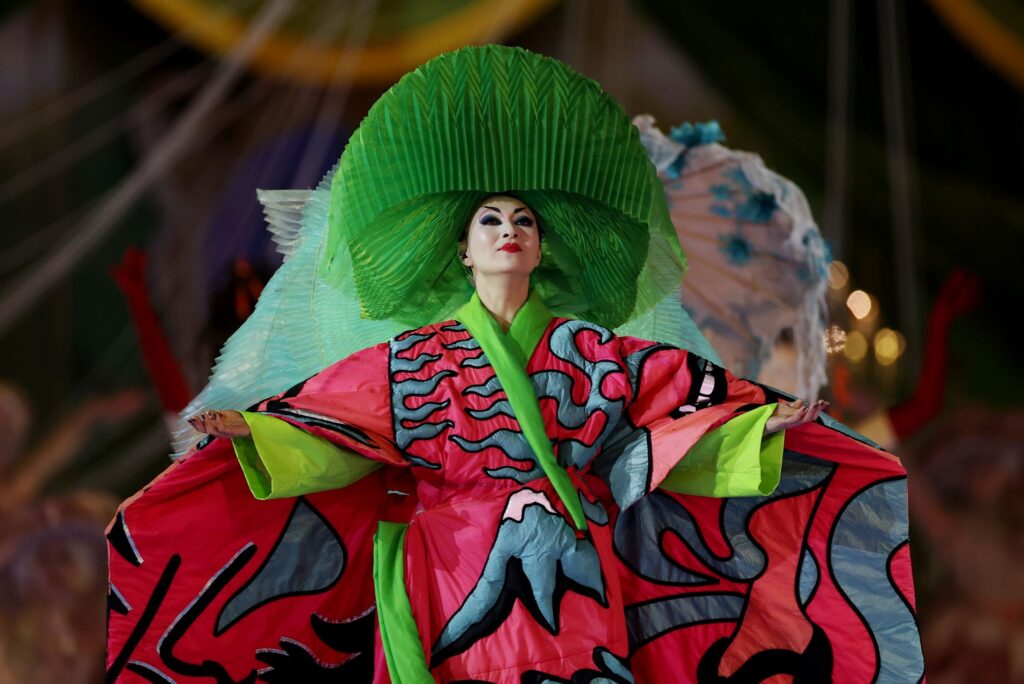
Other fictional celebrities made an appearance during the evening, such as the young Japanese woman Cio-Cio San, alias Madame Butterfly from Puccini’s opera, the demi-mondaine and impossible love of Alfredo, Violetta, heroine of Verdi’s La Traviata, Figaro, the clairvoyant servant who plays tricks on everyone, and Aida, the Ethiopian princess sold into slavery at the Egyptian court. The latter, who appeared in a sculptural golden dress, is closely linked to the history of the venue, as the first edition of the Arena Di Verona festival featured a spectacular performance of Giuseppe Verdi’s masterpiece.
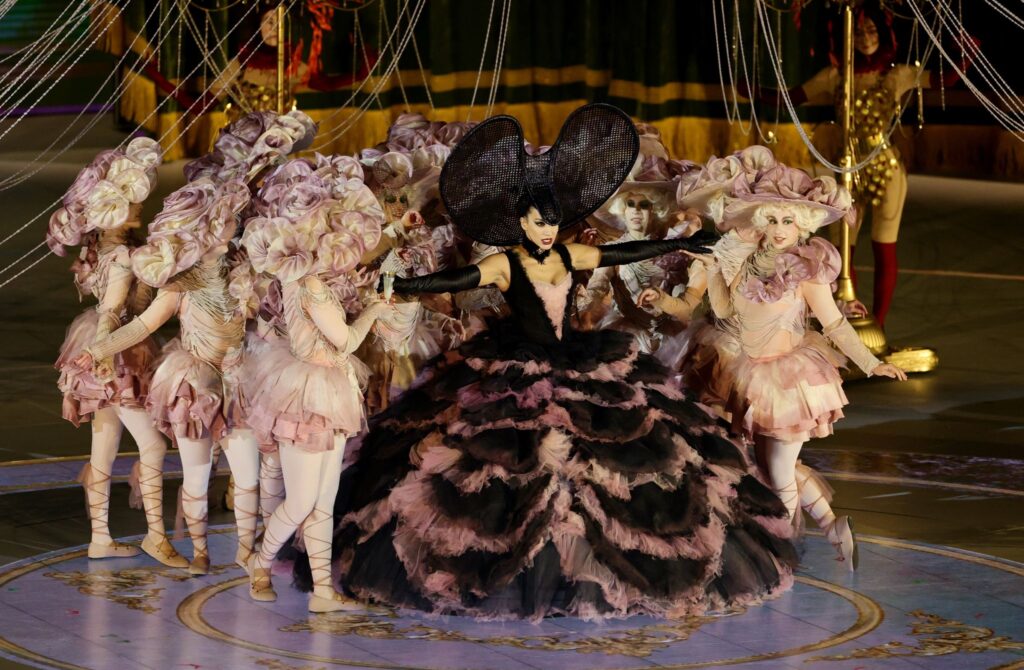
Each character provided an opportunity for creative prowess in the design of the various costumes. Rigoletto’s outfit, for example, was an authentic contemporary reinterpretation featuring upcycled denim pieces from around 40 pairs of jeans and almost as many zippers to create the slits.
Passion for Italo-pop
Opera was not the only musical genre honored that evening, far from it. In fact, the parade of athletes served as a pretext to showcase great popular musical hits, most of which were revealed at the famous Italian song festival in San Remo, which takes place from February 24 to 28, 2026.
Among them were Tony Renis and Emilio Pericoli’s Quando, Quando, Quando, Paolo Conte’s It’s Wonderful, Ricchi e Poveri’s Sarà perché ti amo, and some iconic film soundtracks such as l’Estasi dell’ Oro by Ennio Morricone and Amarcord by Nino Rota.
The contemporary scene was not to be outdone with Ludovico Einaudi’s “Expérience” performed on the piano.
But the evening was marked above all by “una delle personalità più interessanti della scena artistica italiana di oggi” (one of the most interesting personalities on the Italian art scene today), as described in his biography on Spotify, Achille Lauro. After starting out in rap, this Verona native and regular at the San Remo festival enjoyed his first success in 2015 with Young Crazy EP and Dio before establishing himself as a glam pop icon, not to say punk rock. The 35-year-old artist performed “Incoscienti Giovani” from his latest and seventh album, Comuni Mortali, a song whose music video pays homage to Fellini’s La Dolce Vita, notably the famous scene of swimming in the Trevi Fountain.
Meanwhile, Italian DJ Gabry Ponte, who was behind the success of Eiffel 65’s “Blue (Da Ba Dee),” was tasked with setting the mood in the ancient stadium.
Warm-up before the 2030 Alps
Like all Olympic Games closing ceremonies, the evening culminated in the performance of the Olympic anthem before giving way to the handover between the current host country and the future one, namely Italy and France. The mayors of Milan and Cortina d’Ampezzo handed over the flag with the rings designed by Pierre de Coubertin to Renaud Muselier, president of the Provence-Alpes-Côte d’Azur region, and Fabrice Pannekoucke, president of the Auvergne-Rhône-Alpes region.
On this occasion, the promotional film for the upcoming games was unveiled, highlighting Mont Blanc and its 4,806 meters, which served as the backdrop for the very first Winter Games in 1923, not far from there, in Chamonix.
Six years after Paris 2024 and 38 years after the Winter Games in Albertville, France, which can boast an exceptional haul (23 medals, including eight gold), is preparing once again to host the Olympic Games in 2030.
Four regions (Haute-Savoie, Savoie, Briançonnais, and Nice) have been selected to host the next Winter Olympics. As with Milano-Cortina 2026, the festivities will be shared between several locations, ranging from Nice (for the ice events) to Courchevel, via Serre-Chevalier, Méribel, La Clusaz, Val d’Isère, Montgenèvre, and Le Grand Bornand.
A Marseillaise 2.0 combining opera and electro was also performed by Marine Chagnon, mezzo-soprano at the Paris Opera, as the French flag was raised.
The festive spirit continued with the Californian DJ collective Major Lazer, who invited guest stars such as Danish singer MØ and her hit Lean On, released in March 2015. This was a way of reminding everyone that the next Summer Olympics, which are normally known to be more popular, will take place in Los Angeles in 2028.
Read also > Milano Cortina 2026: a spectacular Olympic kick-off
Featured photo: © Fondazione Milano-Cortina