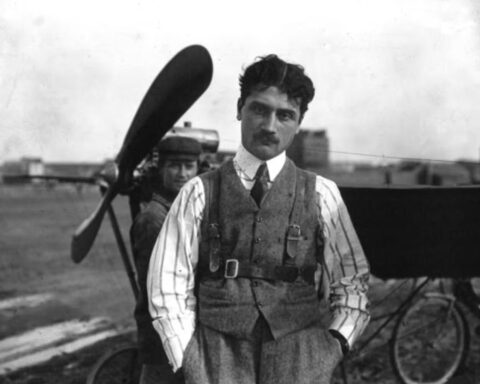







Painter Roger de Montebello opens the doors to his studio in the Contarini Polignac Palace in Venice. His soft, fluid works seem to flow naturally, like the water of the Grand Canal. But it takes a long time for them to mature before he sets his sights on his chosen subject.
Venice is Roger de Montebello’s “chosen city.” After living in Paris, Seville, and Venice, the man with the beautiful name chose the City of the Doges in 1992. “This city suits my sensibility and my balance. I never tire of it. I love this world where water is the mirror of the sky and the earth,” confides the adopted Venetian.
It is in the cultural district of Dorsoduro (the “hard back”), between the famous dell’Accademia museums, the Guggenheim Foundation, and the Punta della Dogana (Pinault collection), that Roger de Montebello awaits us one morning at the foot of the Contarini Polignac Palace.
Out of season, Venice is empty of visitors. Here, you encounter the locals and regulars, the faithful, the aesthetes. Those who like to enjoy a cappuccino in a quiet little bar before the shops and museums open. Paul Morand had his rituals here: “The air has not yet been used; it rushes towards you, freshly washed, coming from the sea.”
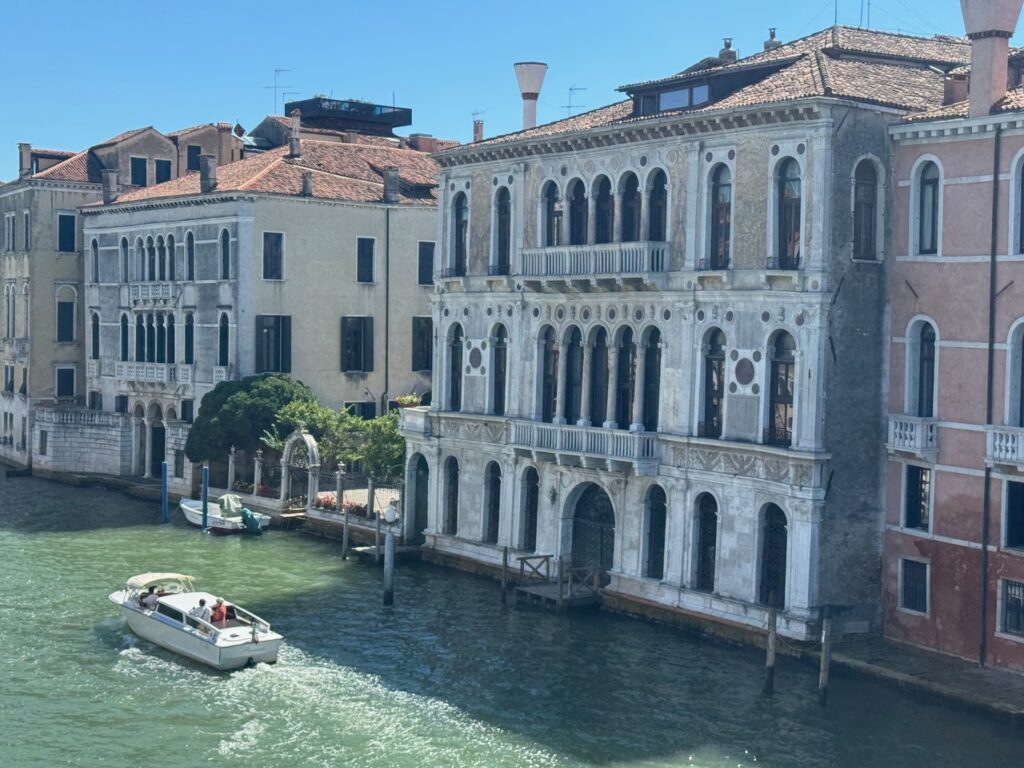
Crossing the Accademia Bridge, we admired the Contarini Polignac Palace (also known as the Contarini Dal Zaffo Palace), one of the first examples of Renaissance architecture in the city. Claude Monet was inspired by it and painted it in 1908. Several families have lived there over the years: the Manzonis, then the Angarans, the Polignacs. And today, the Decazes family.
We walk through the large reception rooms of the Palazzo Contarini Polignac, open to visitors during the Venice Art Biennale, and imagine the excitement, the splendor, the emotion, the encounters…
Then we climb a flight of stairs leading to the studio.
Here we are in the lair of Roger de Montebello, the anti-socialite who focuses entirely on his art. Large paintings on the wall give the place a very special soul. “This painting is not for sale,” he tells us as we take an interest in one of them (three meters long) entitled “Venice, view from the lagoon.”
We understand that its creator would feel bereft if the painting were no longer there. It is a luminous landscape that invites peace and stillness. Oh, time, suspend your flight!
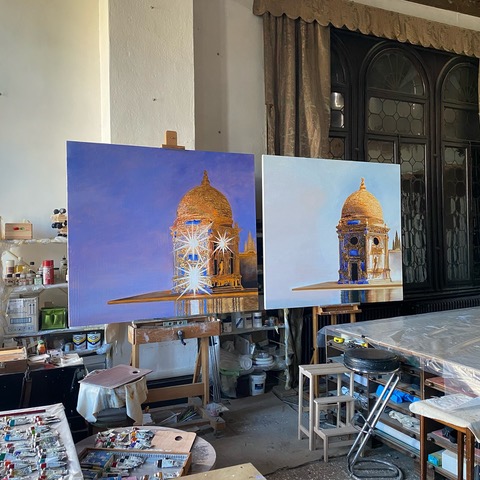
The artist’s colorful (and seemingly rather organized) world consists of small, medium, and large canvases, easels, wooden tables and stepladders, countless boxes of paints and brushes.
Although Roger de Montebello painted the exterior of the Contarini Polignac Palace, he never considered drawing his studio, he confesses. Yet this “world of the interior and the top floor” is not without charm. It is unique, romantic, and timeless. And what a privilege it is to work in this place with one of the most beautiful views in the world: the view of the Grand Canal!
For me, painting is an Apollonian art
La Serenissima has greatly influenced artists, from Italian Renaissance painters to Impressionists and modern-day landscape artists. It has also been shaped and enhanced by their gaze. They have left it a magnificent legacy.
Roger de Montebello recounts: “I have a permanent view of Venice. I contemplate the city and imagine a new painting. It takes a long time to mature before I pick up my pencils and brushes. Then it happens quickly! For me, painting is an Apollonian art. I position myself at the right distance. I target my subject, draw my bow, and release my arrow.”
The arrow hits a landscape, a monument, a face, a horse, a bull, a tree, an apple… Light floods the subject and gives it a life force, an energy that transcends reality, an energy that sometimes causes blood to flow. Isn’t Apollo the god of beauty who favors classicism, order, and moderation, but also a warrior god, a god of combat?
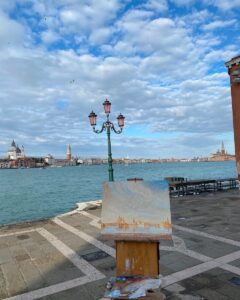
Like the Impressionists, Roger de Montebello likes to paint outdoors. He sets up his easel outside, facing the scene he wants to interpret. He is himself enveloped in the landscape, alone, away from the hustle and bustle of tourists.
He seems to have captured the soul of Venice, which bewitches him. He does not need to disguise himself to communicate with it. He is himself. He is its willing prisoner. He forgets the materiality of the world and concentrates on his subject. With a stroke of his pencil, he draws, transforms reality, and envelops it in light and color.
His sources of inspiration in Venice?
The Punta della Dogana, flooded with light or half-hidden by fog. The Basilica of Santa Maria della Salute, San Giorgio Maggiore, the Church of the Redeemer on the island of Giudecca, the Emilian Chapel on the island of San Michele… Roger de Montebello changes his palette: he loves to paint the colorful houses of the island of Burano, where the orange-red tones are a hymn to life.
He never draws bridges or gondolas, preferring instead to focus on doors… which are gateways to secret passages, mysterious places, and silent beauty. Doors are rich in symbolism and invite us to hide from the world, to preserve our privacy, our joys, our sorrows, our relationships…
Through his pictorial art, Roger de Montebello reinvents the architectural subjects he tackles, using a mineral palette dominated by blues, whites, and ochres that leaves plenty of room for the sky, the sea, and the lagoon. This is where we find his creative touch, his recognizable style.
“Buildings represent habitat, culture, the intellectual world. They are as if projected into the sky and reflected in the water. Monuments, churches, houses are thus absorbed into nature. There is no longer any hierarchy between divine creation and human constructions. The Whole is in the Whole.”
Roger de Montebello is to painting what Patrick Modiano is to literature
Roger de Montebello is not easy to interview. You have to insist before he tells you that he graduated from a prestigious American university.
Born in Paris in 1964, the boy developed an interest in painting at an early age. His Franco-American family, who were involved in the arts, undoubtedly encouraged this awakening. He shares his first name with his grandfather, Roger de Montebello, who was a painter, publisher, art critic, and inventor of the first developments in 3D photography.
After learning the basics of drawing and painting at the Faculty of Fine Arts in Seville, the young man went on to study painting while studying art history at Harvard. He graduated with a Bachelor of Arts degree in 1988. An impressive academic record that deserves to be highlighted!
Back in Europe, Roger de Montebello chose to devote himself entirely to his art. He did not follow in the footsteps of his uncle, Philippe de Montebello, who was director of the Metropolitan Museum of Art in New York for 32 years.
His culture and sensitivity allowed him to quickly make a name for himself. He exhibited his paintings in Paris in 1992. That same year, he set up his open-air studio in Venice, the city where he lives and works today.
France, Spain, Italy, the Cyclades… are his sources of inspiration. His subjects include landscapes, houses, buildings, but also portraits, animals, and bullfights painted in bright red.
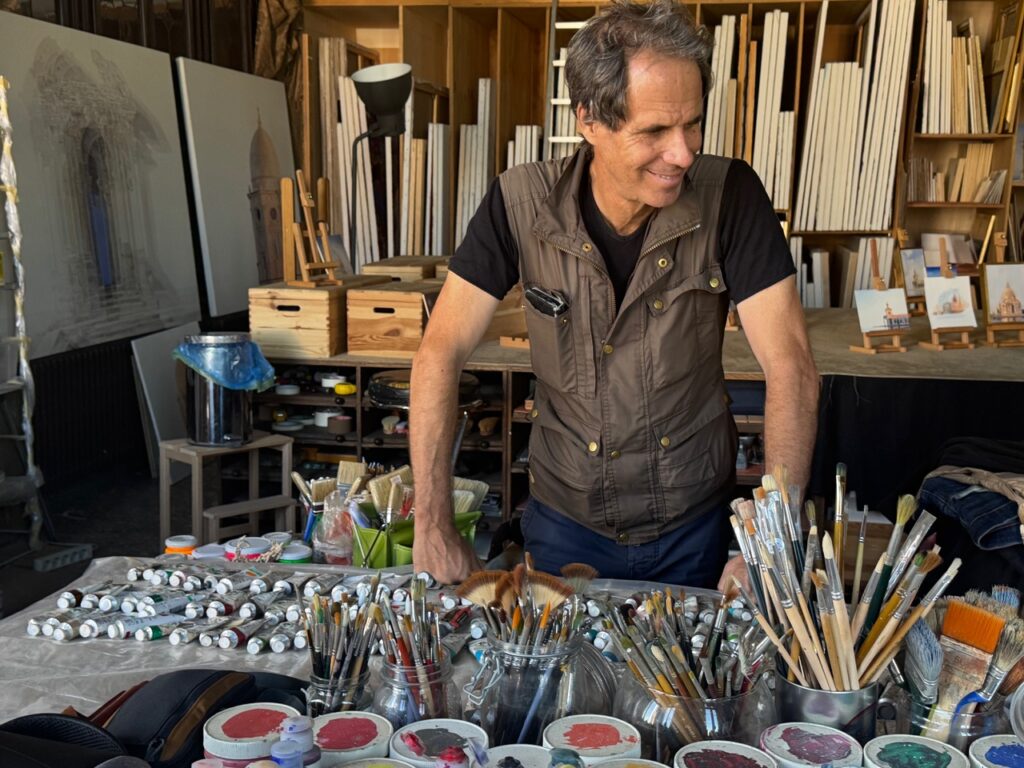
This young man in his sixties does not like to define “his style,” considering it a marketing approach, a flaw of our time that takes away the artist’s freedom.
It is true that Montebello’s work is multifaceted, poetic, and cosmopolitan. It is not limited to views of Venice. But it is his fragments of a love discourse with La Serenissima that we prefer.
In 2011, the Venice Art Biennale presented “Montebello-Megachromia,” and he then exhibited in Paris and London.
In 2017, he was honored at the Correr Museum in Venice, which dedicated an exhibition to him.
In 2021, he exhibited his “Porta delle Terese” and its various imaginary variations at the Espace Muraille gallery in Geneva. Other exhibitions followed abroad…
“I make a living from my painting,” he says, happy that people follow and support his work.
“It’s contemplative rather than metaphysical painting,” Roger de Montebello is keen to point out. “It’s my way of apprehending reality in a calm, still manner. It suits my temperament! I like to focus on the simplicity of forms, on light. I don’t throw a landscape in your face. It asserts itself without being evanescent.”
Montebello’s painting resembles a beautiful woman, elegant and discreet, hiding in the alleys and dead ends of La Serenissima. She is invisible, blending into the background. She is motionless, watching, contemplating. She is absorbed by the dreamlike charm of Venice.
The great Venetian masters, painters of concentration, silence, and the sacred
His painters of reference? Rather than Giorgio de Chirico (1888-1978), one of the founders of the metaphysical painting movement, he prefers to cite great Venetian masters such as Vittore Carpaccio (1465-1525) and Giovanni Bellini (1430-1516), whose works have influenced many generations over the centuries.
“They are painters of concentration, silence, and the sacred. I have a sense of the sacred and respect for all this beauty,” notes the artist. “These painters are very present in me; they nourish me and enrich my vision.”
Roger de Montebello’s works seem to flow naturally, soft and fluid… like the water of the Grand Canal. But the lines are carefully crafted and precise in order to convey the subtleties of Venetian architecture floating in the sky and sea. We feel immersed in a waking dream where the aggression and difficulties of the modern world seem to have disappeared. All that remains is the beauty of Venice, La Serenissima, the city like no other.
Want to know (and see) more? http://www.montebellopaintings.com
https://www.instagram.com/rogerdemontebello/
Read also > In Venice, Chahan Minassian breathes new life into the Fortuny residence, the sleeping beauty of the lagoon
Featured photo: Roger de Montebello in his studio at the Palazzo Contarini Polignac ©Corine Moriou