





Just in time for Halloween, the creature born on a stormy night has invaded our daily lives, from movie theaters to comic books to health and politics. This month, “Frankenstein” was even used to describe the new COVID variant and the projected Lecornu II government budget. Behind this appeal to sensationalism, it is difficult not to see a warning against certain irrational “advances.”
“Science without conscience is but the ruin of the soul,” wrote Gargantua to his son Pantagruel in Rabelais‘ novel. Of all the contemporary monsters that have become cult figures, no one embodies this maxim better than the well-known creature and its eponymous creator, Dr. Victor Frankenstein.
Scouring cemeteries, desecrating graves in search of body parts, and watching for lightning—electricity not having been discovered until 61 years later by Thomas Edison—the famous Dr. Frankenstein, imagined by British novelist Mary Shelley and dreaming of being God’s equal, achieved the unthinkable: creating a living being from scratch. Horrified by his nightmarish creation, the doctor fled, leaving the creature to fend for itself as it tried in vain to be loved, precipitating tragedy.
A nightmarish book born out of a literary contest
1816 turned out to be a year without summer. This was most likely due to the eruption of the Indonesian volcano Tambora, which spewed ash into the atmosphere and disrupted the climate. That year, there was almost no sunshine, and torrential rains destroyed the crops. Cereals and vines did not ripen, while potatoes rotted on the ground. The Germans called this period of desolation “the year of the beggar.”
In Switzerland, too, the cold set in. At the Villa Diodati, on the shores of Lake Geneva, a group of five friends enamored with romanticism killed time by reading ghost stories. They also discussed Luigi Galvani’s latest electrical experiments and Erasmus Darwin’s reanimation of dead matter.
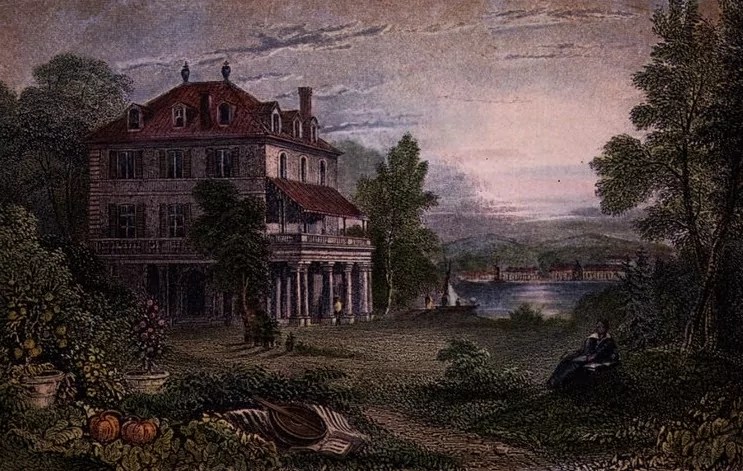
This was no ordinary group; it brought together a host of rising stars of Gothic literature, such as Mary Shelley (at that time Godwin) and John William Polidori. They were also accompanied by the famous and scandalous poet and dandy Lord Byron. Not really on vacation, the man who rented the villa had been banished from England following allegations of incest with his half-sister. That summer, the group also included Mary Shelley’s future husband, the poet Percy Shelley and Claire Clairmont, Mary Shelley’s half-sister.
Bored by the overly conventional stories in the collection Fantasmagoriana, translated from German, Lord Byron suggested they “do better.” So a real writing contest was improvised in the vast mansion.
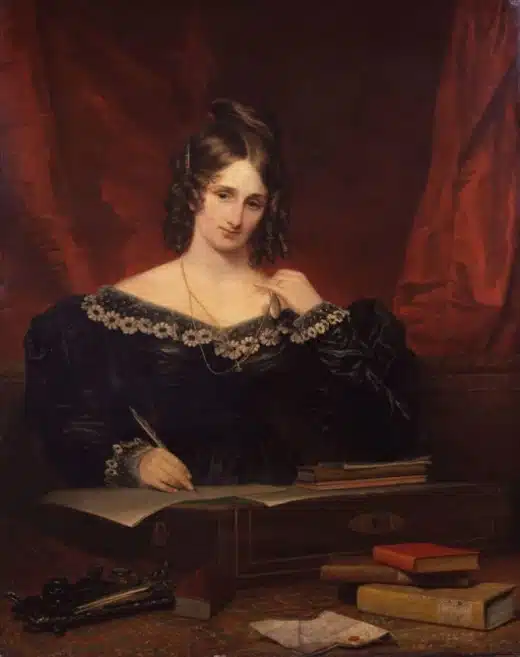
Two works born in this atmosphere of emulation would remain for posterity: The Vampyre by John William Polidori, the ancestor of Bram Stoker’s Dracula, but above all Frankenstein.
Mary Shelley is said to have seen the latter story in a dream, or rather a nightmare. One night, “she saw the horrible specter of a man lying down, then, under the effect of a powerful motor, showing signs of life,” she wrote in her diary.
Mary Shelley’s first novel, written when she was only 19, Frankenstein; or, The Modern Prometheus, was published anonymously in January 1818, before being revised in 1830.
Death and its looming shadow
In the novel, death is omnipresent, whether through the creature itself, created from corpses, or through its many victims (particularly those close to the scientist Frankenstein), leading to the destruction of his family.
It is not surprising that, before publishing her first novel Frankenstein, Mary Shelley had experienced death. Her mother, the feminist philosopher Mary Wollstonecraft, died when she was only ten days old. Together with her husband, the poet Percy Shelley, they had to cope with the death of three of their children. A fourth child, Percy Florence Shelley, was the only one to survive.
Infant mortality most likely fueled the author’s reflections on the creation of life, motherhood, and loss. In this sense, her work Frankenstein can be read as a metaphor for giving life while risking suffering, death, and even rejection.
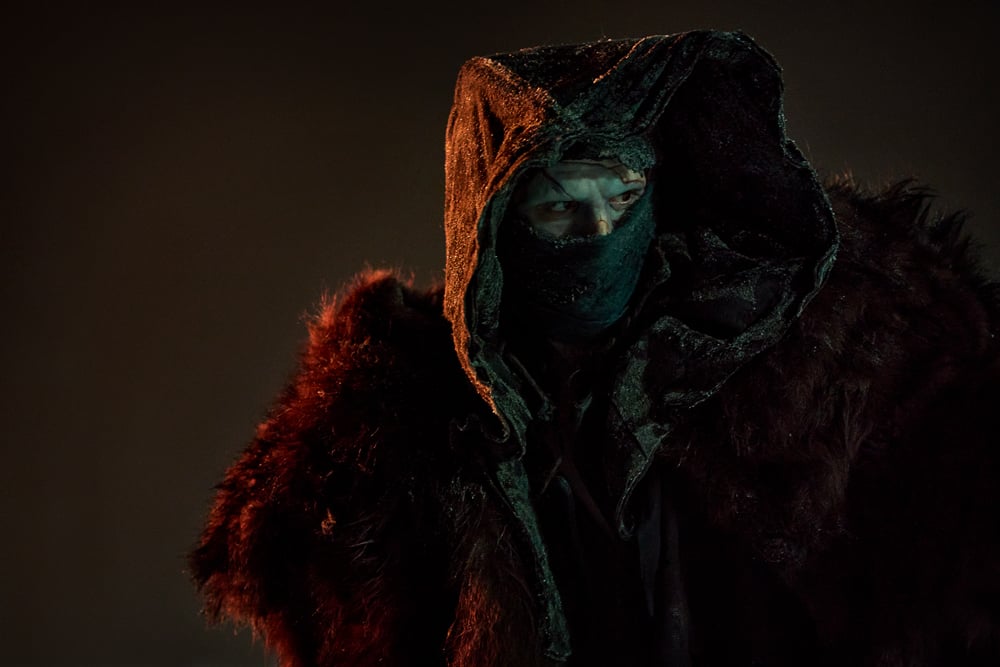
Rejection by humans, including its creator, causes the creature in the novel to feel deeply isolated, mirroring the existential loneliness Mary Shelley experienced following the loss of her mother and three of her children. But this rejection can also be seen in terms of difference, mirroring the unconventional morals of Mary Shelley, who was a proponent of polyamory ahead of her time in Victorian England.
Mary Shelley’s family ended up in tatters: Mary Shelley also lost her half-sister Fanny Imlay, who was her husband’s first wife and committed suicide, and her husband, who drowned in the Gulf of La Spezia during a storm. This last tragedy occurred four years after the publication of Frankenstein.
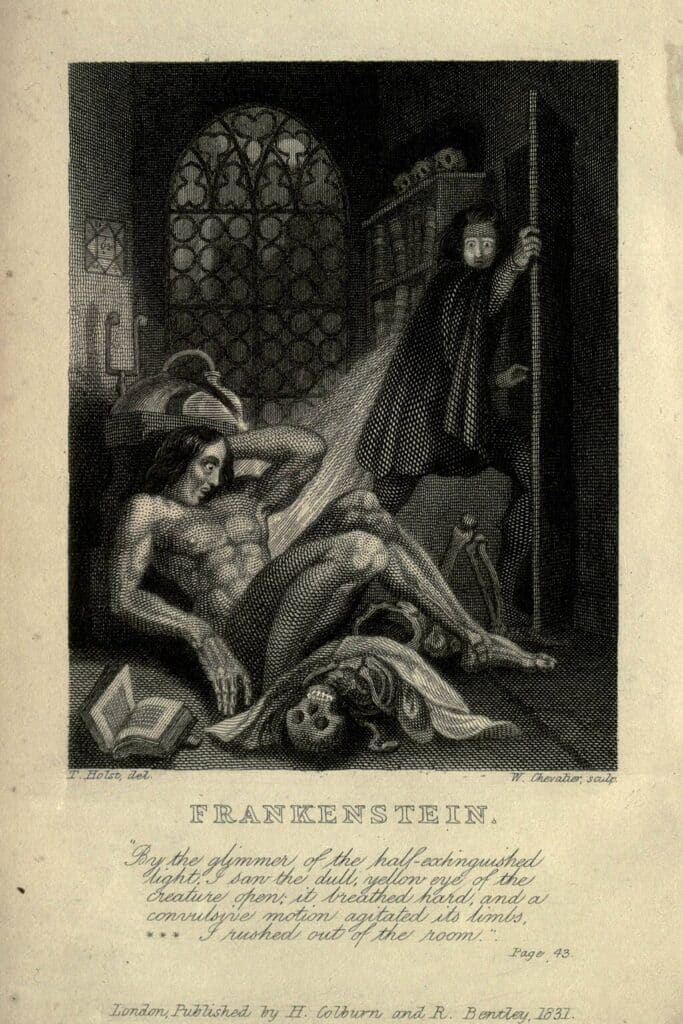
But the novel cannot be reduced to a simple morbid work: Frankenstein, a pioneering work of science fiction, contains a philosophical reflection on the dangers of science and excessive ambition.
It is no coincidence that Mary Shelley titled her work Frankenstein, or The Modern Prometheus. She thus refers to the titan Prometheus, a character from Greek mythology who suffered the wrath of Zeus for stealing the sacred fire of the gods of Olympus and giving it to mortals. His divine punishment was to have his liver devoured by an eagle every day while he was chained to a rock.
In the novel, Victor Frankenstein embodies the Promethean scientist who oversteps human limits, seeking to rival God or nature. Thus, the book reflects Mary Shelley’s anxieties about scientific progress and the moral consequences of knowledge without responsibility.
Amidst the madness of men, the creature seeks only one thing: to be loved. It asks the scientist to create a wife for it. After doing so, however, the scientist destroys his new creation, arousing anger and desolation in the one for whom it was intended.
Endless stormy nights
Although the monster in the novel is gifted with a heart and the power of speech (even adept at formal language), Hollywood turned him into the archetype of the “stupid and evil” monster.
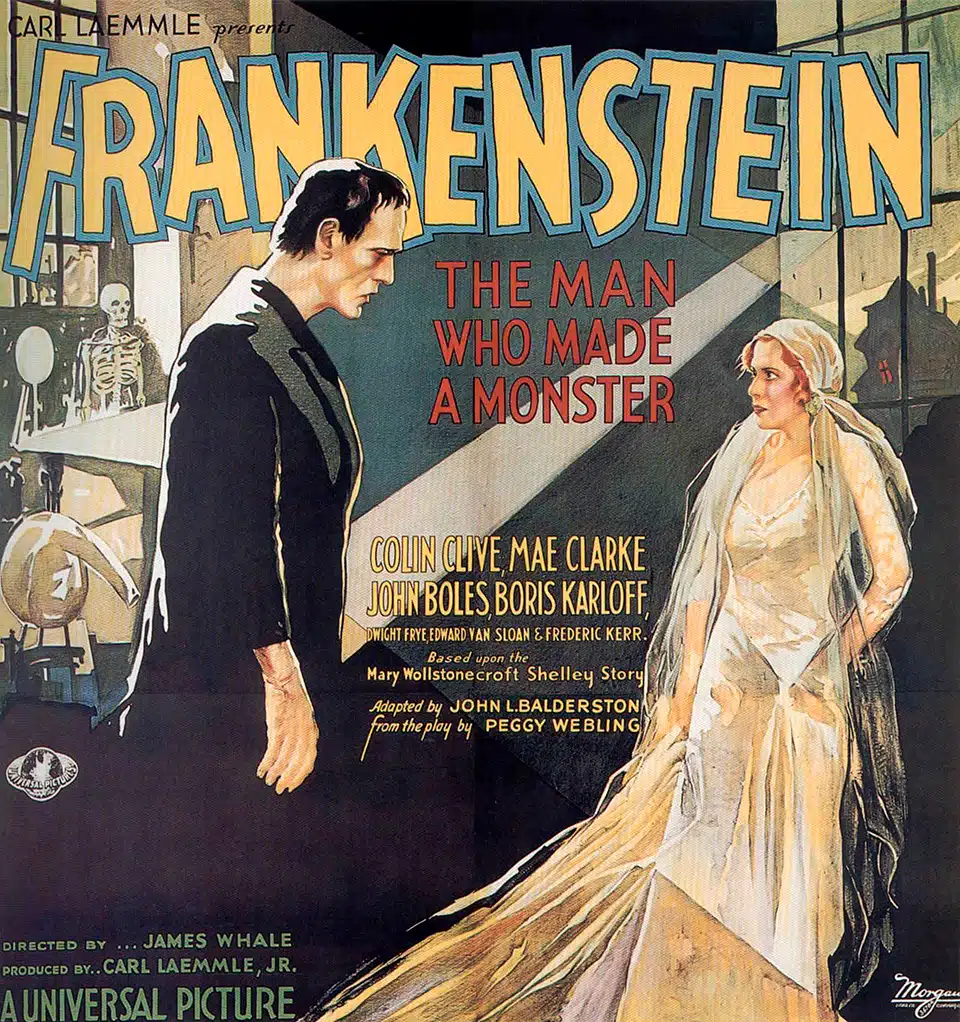
The performance of actor Boris Karloff in the 1931 film adaptation by James Whale and Universal Studios would influence how the monster was portrayed. The same was true of the makeup created by Jack Pierce, which was then used throughout the Universal Monsters series. The monster’s giant size (“eight feet tall, or 2.43 meters”) is undoubtedly one of the few original characteristics inherited from the novel. The studios thus abandoned the yellow skin revealing muscles and veins, very white teeth, and colorless eyes. Conversely, Frankenstein inherited other iconic features. These would go on to dominate horror cinema and delight costume sellers, namely a cylindrical head, a very thick forehead, bolts in the neck or temples, and flesh covered with stitches.
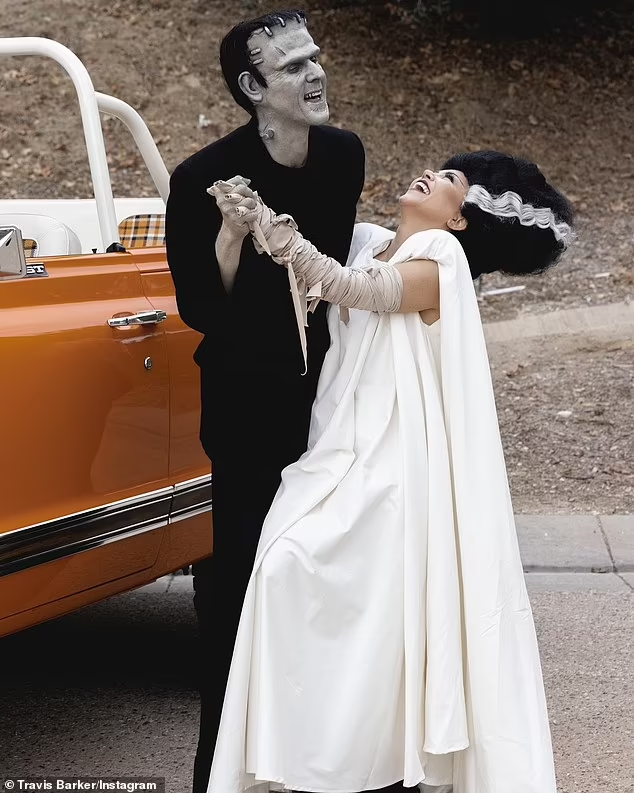
In 1935, the creature’s female counterpart shared the screen with The Bride of Frankenstein, a purely symbolic character in the novel. Like her big brother, she has easily identifiable features, namely black hair styled into a cone with two white streaks on the sides, very pale skin, and an expressive, frightened look. The character also inspired a Halloween costume in 2022 for Kourtney Kardashian and her then-husband Travis Barker, as well as Kylie Jenner.
The work has already spawned some 60 film adaptations, and nearly 400 films, series, and works of fiction feature the creature.
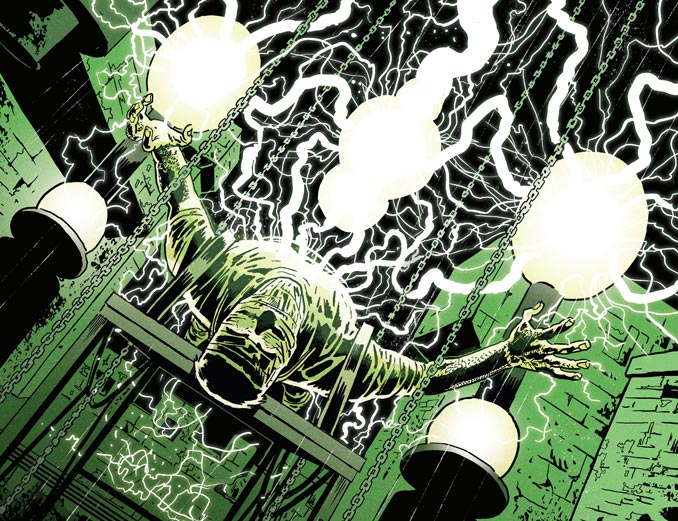
At Urban Comics, illustrator Michael Walsh revisits this month’s comic book adaptation of the key 1931 film in a work soberly titled Universal Monsters: Frankenstein.
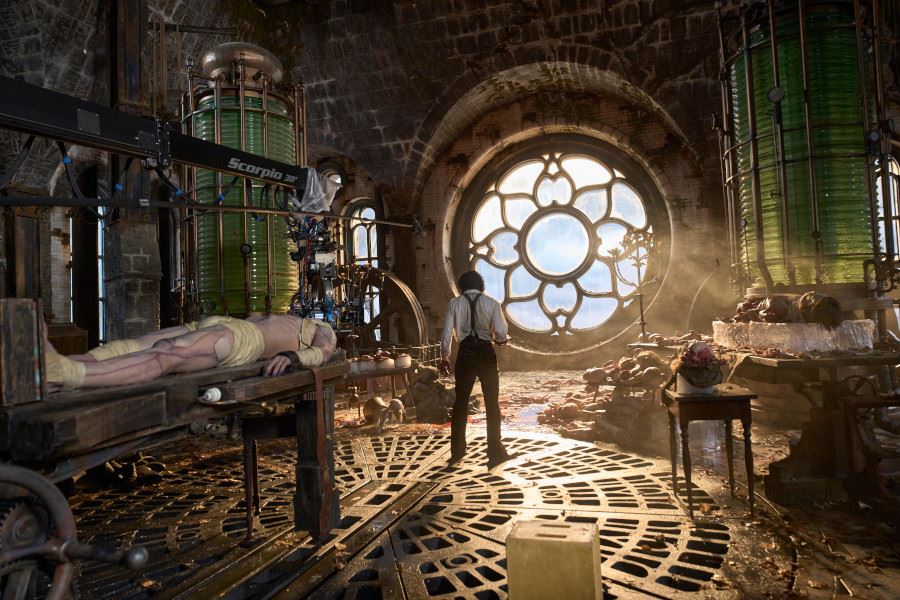
Meanwhile, Mexican director Guillermo del Toro is releasing his own adaptation of Mary Shelley’s bestseller on Netflix on November 7. Victor Frankenstein is played by Oscar Isaac, while Jacob Elordi lends his features to the Creature. Far from the conventional Hollywood gloss, the director of Pan’s Labyrinth has chosen to return to the dark and poetic fundamentals of the novel, which remains undoubtedly one of the most humanistic works of Gothic literature.
Read also > Dracula: the origins of evil with its author, Bram Stoker
Featured photo: © Netflix